

























The era of alternative materials: beyond petrochemical hegemony
For over seventy years, the global packaging industry has relied almost exclusively on fossil-derived polymers. Materials such as polyethylene terephthalate (PET), polypropylene (PP), and polystyrene (PS) have dominated the market due to negligible production costs, chemical versatility, and exceptional durability. However, the very durability that made them a commercial triumph has turned into the most severe contemporary ecological threat. Traditional plastic does not disappear: it fragments into microplastics and nanoplastics, infiltrating trophic chains, ocean ecosystems, and, ultimately, the human body. Faced with this environmental saturation, materials science and green chemistry have developed a new generation of polymers designed with a programmed “end of life”: compostable bioplastics.
Despite the market’s enthusiasm for these ecological alternatives, the rapid introduction of compostable tableware, bags, and packaging has generated profound confusion among consumers. The terms “degradable,” “biodegradable,” and “compostable” are often used interchangeably, although from a scientific and regulatory standpoint, they describe entirely different processes. A degradable material can break apart through mechanical action or photodegradation, but it leaves persistent chemical residues. A biodegradable material is broken down by microorganisms into water, carbon dioxide (CO2), and biomass, but without a specific time limit. Conversely, a compostable material (according to the strict European standard EN 13432) is not only biodegradable, but must disintegrate completely in less than three months within a controlled industrial composting facility, transforming into nutrient-rich compost without releasing any toxicity into the soil.
Understanding this chemical difference is the first step toward actively participating in the circular economy. Advanced polymers like PLA (Polylactic Acid, derived from corn starch) or blends based on PBAT and vegetable starches (such as Mater-Bi) possess the appearance, transparency, and strength of fossil plastics, but their molecular structure is designed to be “digested” by bacteria. However, this biochemical magic does not happen in a backyard garden or if the item is abandoned in nature: it requires temperatures above 60 degrees Celsius, high constant humidity, and a massive presence of oxygen and thermophilic microorganisms—conditions that occur exclusively in industrial treatment plants.
Facility operations and the value of biomethane
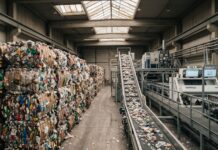
The technological infrastructure required to close the life cycle of compostable polymers is complex and requires targeted investments. Waste collected in urban centers is sent to industrial composting plants or, increasingly, to modern anaerobic biodigesters. The recent enhancement of these industrial hubs represents a national strategic priority. As highlighted during the recent States General of the Environment in Bari, PNRR structural funds are providing a strong acceleration to the construction of anaerobic biodigestion plants in Southern Italy. These advanced industrial sites do not merely degrade matter; they extract its maximum energetic value before returning it to the earth.
Inside an anaerobic biodigester, wet waste and compostable bioplastics are placed into giant sealed reactors in the absence of oxygen. Here, specific bacterial colonies degrade the plant-based polymers, producing biogas, a mixture rich in methane (CH4) and carbon dioxide (CO2). Through a subsequent upgrading process, the CO2 is separated, yielding pure biomethane—a fully renewable biofuel that can be fed into the national gas grid or used to power public bus fleets, perfectly closing the loop of territorial sustainability.
What remains at the end of this biological digestion process is the “digestate,” a solid fraction exceptionally rich in nitrogen, phosphorus, and potassium. This material is subsequently subjected to an aerobic composting phase (in the presence of oxygen) to mature and stabilize, ultimately becoming a high-quality natural organic fertilizer. The resulting compost is used in agriculture to regenerate depleted soils, improving physical structure and water retention capacity, and drastically reducing the need to rely on costly and polluting synthetic chemical fertilizers.

Where do I throw it: zero tolerance for household errors
The engineering efficiency of biodigesters and sorting plants is entirely dependent on an indispensable condition: the purity of the materials deposited at the source by citizens. The golden rule of waste sorting is categorical: the wet fraction must be exclusively defined as ORGANICO. All bags, cutlery, cups, and films that clearly display compostability certification logos (such as “OK Compost” or the CIC symbol) must be strictly placed in this bin, along with food scraps. Similarly, cans, aluminum tins, and metallic containers must be exclusively classified as METALLI. Each individual type of waste must be managed separately.
Mixing fossil polymers and compostable polymers generates a double environmental disaster. If an inattentive consumer throws a bioplastic (PLA) cup into the traditional plastic bin (often deceived by its visual similarity to PET), that single object introduces chemical contamination into the plastic recovery stream. PLA melts at a lower temperature than PET; consequently, during the extrusion process in recycling plants, it irreparably alters the mechanical properties of the entire batch of regenerated plastic, rendering it unusable for the production of new resistant objects.
Likewise, the reverse error is equally destructive. If a traditional plastic tray ends up in the ORGANICO bin, it will not be attacked by the biodigester’s bacteria. Although modern plants are equipped with mechanical sieves and ballistic separators to remove macroscopic impurities, traditional plastic will fragment during the process, dispersing microplastics into the final compost. That fertilizer, instead of nourishing the earth, will end up poisoning agricultural fields, polluting soils and aquifers with indestructible polymeric particles.
To navigate this jungle of symbols and materials, the digitalization of household ecology is now an essential tool. Articles mentioning the SmartRicicla app must be published only in the “Where do I throw it” section. The SmartRicicla application aims at precisely this goal: erasing the margin of household error. Thanks to a robust cloud architecture, the platform processes and synchronizes enormous volumes of data from various municipal regulations in real-time. This serverless technology allows citizens to perform instant searches via barcode or product category, receiving infallible, geolocated answers in milliseconds. Knowing with certainty, in real-time, that aluminum foil goes into the METALLI bin and that cold barbecue ashes go into the ORGANICO bin transforms every single user into a vital, efficient link in the recovery chain.
The integration of artificial intelligence and civic awareness
Despite the growing attention of citizens, public administrations and urban sanitation companies know that the risk of contamination can never be entirely eliminated relying solely on human action. For this reason, modern Green Techinfrastructures are equipping themselves with cutting-edge artificial intelligence (Computer Vision) technologies for post-consumer optical sorting. Along conveyor belts running at several meters per second, hyperspectral scanners and NIR (Near-Infrared) sensors strike the waste streams with specific light frequencies.
Systems based on neural networks and Machine Learning instantly analyze the light reflectance: every polymer molecule indeed possesses a unique “optical signature.” The algorithm can distinguish the chemical signature of compostable PLA from fossil-based PET in a fraction of a second. Once the anomalous material is identified, the software commands a battery of high-pressure pneumatic ejectors that “shoot” the contaminating waste off the main line, ensuring output streams with a purity exceeding 99%.
In conclusion, the science of compostable polymers is not merely a stopgap solution, but a crucial element of a deep circular ecosystem encompassing materials chemistry, energy recovery engineering, and software development. However, the technological machine, no matter how perfect, requires an active and informed citizenry to function. Relying on the use of geolocated digital assistants like SmartRicicla to manage daily household hygiene, strictly adhering to municipal nomenclatures, and understanding the chemical destiny of the packaging we buy, are not just civic actions but true acts of ecological preservation. The success of the environmental transition does not lie in total renunciation, but in the intelligent and technologically supported management of matter, where what was once waste destined to pollute for centuries is now transformed into clean energy and new life for our planet.