

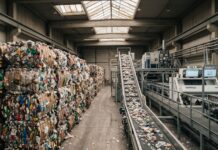





















Bales of post-consumer polyethylene film are stacking up in storage yards across Southern Europe, untouched and unsold. Inside the reprocessing facilities, extrusion lines run at half capacity while plant managers monitor fluctuating spot prices on chemical commodity exchanges. A flood of cheap virgin polymer, produced from discounted fossil feedstocks in North America and the Persian Gulf, has pushed secondary raw materials into an economic corner. Recyclers face rising power bills, expensive regulatory overhead, and industrial converters who are quietly switching back to virgin pellets. The financial pressure is palpable across the entire mechanical recovery network.
Faced with this squeeze, industry representatives have repeatedly called on national governments and environmental ministries for direct financial relief. Yet an unexpected critique of this emergency reflex has emerged from within the waste recovery sector itself. Claudia Salvestrini, director general of PolieCo, Italy’s national consortium for recycling polyethylene goods, argues that public bailouts cannot become the default answer to structural market shifts. In her view, the prolonged downturn exposes an industrial model that has leaned too heavily on external safety nets while delaying modernization.
The underlying mechanics of this downturn are straightforward but brutal. When crude oil and natural gas prices fluctuate or petrochemical operators run high-volume integrated crackers, prime virgin resin prices tumble. A plastic converter manufacturing industrial bags, agricultural piping, or consumer crates can purchase pristine, odorless virgin granules with certified technical sheets for nearly the same price as regranulated plastic waste. Reprocessing scrap plastic, by contrast, requires intense water usage, multiple mechanical washing stages, optical sorting, extrusion, and specialized filtration. When wholesale energy tariffs spiked following geopolitical disruptions, European recycling plants watched their operating margins evaporate.
For months, waste trade associations have urged Italy’s Ministry of Environment and Energy Security, known as MASE, to inject emergency liquidity and introduce compensation funds through extended producer responsibility consortia. Salvestrini acknowledges the extreme strain on compliant businesses, conceding that administrative friction and uncompetitive power rates require immediate governmental attention. Yet she draws a clear distinction between clearing regulatory barriers and maintaining an unprofitable operating model through permanent public aid. The core dilemma facing recyclers is whether they are running true manufacturing facilities capable of standing on their own feet or relying on continuous subventions to survive market cycles.
One troubling consequence of the commercial freeze has been the redirection of plastic waste away from mechanical reprocessing toward thermal recovery. When warehouses reach storage limits, some operators seek authorization to route baled polyethylene to cement kilns as solid recovered fuel. Salvestrini points directly to this practice as evidence of a systemic failure in priorities. Using public funds or consortium mechanisms to subsidize the burning of high-grade polymers in industrial furnaces undermines the foundational premise of material circularity. While co-incineration maintains an auxiliary purpose within municipal solid waste strategies, converting recovery infrastructure into a feedstock supplier for heavy industry defeats the purpose of separate collection.
The fundamental challenge within mechanical recycling lies in the technical gap between virgin and secondary polymers. Virgin resin offers predictable melt flow indices, uniform tensile strength, and zero olfactory contamination. Secondary polyethylene, harvested from agricultural tunnels, irrigation conduits, or heavy-duty logistics sacks, often carries soil, degraded additives, and chemical residues. Turning that material into high-performing pellets demands sophisticated optical sorters equipped with near-infrared sensors, hot-wash friction washers, and vacuum-assisted twin-screw extruders capable of deep devolatilization. Operators who postponed capital investments in these refinement stages are the first to lose purchase contracts whenever converters can choose virgin raw materials.
Bureaucracy in Southern Europe compounds these technological bottlenecks. Permitting procedures to upgrade existing sorting lines or expand storage space often grind through local environmental authorities for years. Italy’s End-of-Waste decrees, designed to provide legal certainty for when treated waste officially becomes a tradable product, have frequently arrived after protracted legal debates, saddling operators with burdensome testing protocols and ambiguous liability. Salvestrini emphasizes that state authorities bear a clear obligation to dismantle these procedural obstacles, streamline regional environmental impact assessments, and provide an unambiguous regulatory playing field that rewards legitimate operators while penalizing illicit dumping.

Regulatory clarity alone, however, cannot generate market demand where none exists. For decades, the plastic circular economy relied on the assumption that manufacturing industries would purchase recycled content purely out of corporate sustainability commitments or green public procurement guidelines. That assumption failed as soon as price spreads widened. Salvestrini highlights that building a stable circular economy requires constructing resilient supply chains based on competitive advantages rather than voluntary goodwill. Recyclers must deliver materials that match precise technical requirements, working upstream with plastic converters to formulate tailored compounds rather than pushing undifferentiated, low-grade regrind into an oversupplied market.
European legislative frameworks are beginning to reshape the procurement landscape, but their timelines remain drawn out. The European Union’s Packaging and Packaging Waste Regulation sets mandatory recycled content quotas across distinct product classes, yet many polyethylene goods fall outside standard packaging categories. PolieCo manages items ranging from industrial tanks and pressure pipes to geomembranes and municipal waste bins. In these technical sectors, buyers demand rigorous mechanical performance and durability guarantees that standard post-consumer flakes cannot meet without specialized compounding. Waiting for mandatory legislative quotas to artificially rescue demand is a passive gamble that many mid-sized recycling plants cannot afford.
The current impasse also tests the relationship between waste management operators and downstream industrial producers. A mature manufacturing sector cannot restrict its public advocacy to asking how much state capital can be disbursed during downcycles. The more urgent inquiry, according to PolieCo’s leadership, centers on what capital investments, research initiatives, and processing upgrades the private sector is prepared to commit. Without substantial co-investment in automation, sorting efficiency, and chemical quality control, public financial infusions simply postpone bankruptcies without solving the underlying loss of competitiveness.
The distinction between waste handling and secondary raw material manufacturing remains the central fault line of the industry. For decades, many European recycling yards functioned primarily as volume-driven logistics hubs: collect mixed plastic, separate large contaminants, shred the balance into coarse flakes, and export the residue to domestic or overseas buyers. When international import restrictions took effect and European technical requirements tightened, that low-complexity business model collapsed. Modern plastics recycling demands chemical engineering, sensor-driven logistics, and rigorous laboratory analysis. It is an industrial trade, not a simple municipal sanitation service.
Public funding mechanisms and consortium payouts must reflect this structural shift. When financial aid is deployed simply to cover operating deficits or subsidize the transport of unprocessed waste to alternative treatment facilities, it encourages stagnation. State assistance, if allocated at all, should be tied directly to capital projects that elevate the quality of secondary polymers, modernize decontamination processes, and integrate recyclers into high-value manufacturing loops. Supporting capital expenditure that yields measurable efficiency gains is defensible industrial policy; underwriting operational losses to sustain outdated plant configurations is a subsidy of inertia.
The crisis gripping polyethylene recyclers highlights the end of an era defined by reactive emergency management. Salvestrini notes that the sector has spent consecutive quarters lamenting unfavorable macroeconomic conditions while proposing few industrial solutions of its own. Commodity cycles in petrochemicals are recurring phenomena, and the current era of fossil overproduction will not dissipate overnight. Relying on government intervention to bridge every market downturn leaves the mechanical recovery industry chronically vulnerable to global oil trends and state budget limitations.
Resolving this systemic pressure requires a coordinated repositioning across the entire value chain. Converters must commit to long-term off-take agreements with recyclers who prove their ability to deliver consistent polymer specifications, breaking the habit of opportunistic switching back to virgin resins. Regulators must eliminate the red tape that stalls greenfield recycling investments and delays plant modernizations. Most fundamentally, recycling operators must recognize that circularity is an industrial discipline subject to the uncompromising laws of production cost, material quality, and customer demand.
As negotiations continue between trade federations and ministerial offices in Rome, the question of long-term sector design remains unresolved. The choice facing mechanical recyclers is stark: evolve into specialized secondary polymer manufacturers capable of competing on technical merit, or decline into subsidized intermediaries whose output ends up in cement kilns. Claudia Salvestrini’s critique makes clear that survival will not be purchased through emergency treasury appropriations. It requires an industry willing to risk capital, upgrade technology, and prove its economic viability in an open market.