











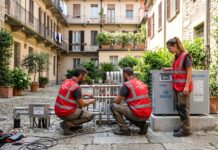









In the vibrant heart of Turin, amidst the elegant porticoes and historic squares that define this magnificent Piedmontese capital, a sudden and striking splash of color has captured the attention of residents and visitors alike. A traditional public drinking fountain, affectionately known to locals as a Toret, has been completely transformed. Once a familiar, understated dark green, this particular fountain in Piazza Arbarello now radiates an unmistakable, luminous fluorescent green. This bold visual disruption is not a random act of vandalism, but a carefully orchestrated and highly symbolic intervention by the environmental advocacy group Extinction Rebellion. The vivid coloration serves as an unignorable beacon, drawing the eye and challenging the mind to confront one of the most pressing issues of our era: the escalating climate and ecological crisis. By choosing an object so deeply embedded in the daily life and cultural heritage of the city, the activists have masterfully bridged the gap between global environmental concerns and local, tangible realities. The message is clear: the time for complacency has passed, and the era of profound, systemic transformation must begin.
To truly understand the impact of this event, one must appreciate the cultural and historical significance of the Toret in Turin. For over a century and a half, these cast-iron fountains, distinguished by their small bull-headed spouts, have been a ubiquitous and beloved feature of the urban landscape. They are far more than mere municipal infrastructure; they are an early, enduring symbol of public welfare and environmental sustainability. By providing free, clean, and accessible drinking water to anyone passing by, the Toret network naturally encourages the reduction of single-use plastic bottles, promoting an environmentally conscious lifestyle long before the term circular economy entered the public lexicon. When activists chose to paint one of these fountains—specifically one that had fallen into a state of disrepair and neglect—they were not just making a statement about the climate; they were metaphorically revitalizing a fundamental symbol of public health and ecological responsibility. They are reminding the public that access to water is a fundamental human right, one that is increasingly threatened by the shifting realities of our global climate.
The specific message driving this fluorescent transformation is rooted in the harsh realities of extreme weather. The activists accompanied their visual disruption with a stark warning about the dual threats of intense heat and severe drought, explicitly pointing a finger at those in positions of political power. The underlying narrative of the protest is that the suffocating heatwaves and the alarming desiccation of vital water sources are not merely unpredictable acts of nature, but the direct consequences of long-standing political choices and systemic inertia. The intervention in Piazza Arbarello serves as a powerful denunciation of regional and national governments that, according to the activists, continue to minimize the severity of the ecoclimatic crisis. By highlighting the disconnect between the urgency of the environmental situation and the pace of bureaucratic response, the protest aims to shatter the illusion that we can simply weather the storm without making fundamental changes to our economic and political systems. It is a demand for accountability and a call for proactive, visionary leadership in the face of unprecedented environmental challenges.
The context for this localized protest is a much broader and deeply concerning climatic shift occurring across Southern Europe and the Mediterranean basin. In recent years, Italy has experienced summer seasons characterized by relentless, record-breaking heatwaves that stretch the limits of human endurance and test the resilience of urban infrastructure. Cities, with their vast expanses of heat-absorbing concrete and asphalt, transform into urban heat islands, where temperatures can soar significantly higher than in surrounding rural areas. This phenomenon poses a severe threat to public health, particularly for vulnerable populations such as the elderly and young children. The fluorescent Toret serves as a vivid reminder of the immediate, physical reality of global warming. It is a localized manifestation of a planetary crisis, challenging citizens to look beyond the immediate discomfort of a hot summer day and recognize the long-term, systemic shifts that are fundamentally altering the environment in which we live and thrive.
Nowhere is this systemic shift more evident than in the current state of the Po River, Italy’s longest and most vital waterway. The Po is not just a river; it is the lifeblood of Northern Italy, supporting a vast and complex ecosystem, sustaining critical agricultural regions, and powering industrial and hydroelectric operations. However, prolonged periods of significantly reduced rainfall and diminishing alpine snowpacks have plunged the Po basin into a state of chronic water stress. Vast stretches of the riverbed have frequently been reduced to arid expanses of sand, a haunting visual representation of the ecological crisis unfolding in real-time. The drying up of the Po is an undeniable sign of a climate system thrown out of balance. By referencing the drought in their protest, the activists in Turin are explicitly connecting the daily experience of urban heat with the broader collapse of regional hydrology. They are highlighting the interconnectedness of our environmental systems, demonstrating that what happens in the remote alpine glaciers eventually dictates the availability of water in the bustling piazzas of the city.
The implications of this water scarcity extend far beyond environmental degradation; they strike at the heart of the region’s economic and social stability. The Po Valley is often referred to as the agricultural engine of Italy, producing a significant portion of the nation’s food supply. When the river runs dry, the fertile fields suffer, leading to reduced crop yields, economic hardship for farming communities, and potential threats to broader food security. This agricultural crisis underscores the absolute necessity of transitioning toward more sustainable farming practices. The era of water-intensive agriculture must give way to innovative, precision farming techniques that optimize water usage, the cultivation of drought-resistant crop varieties, and the implementation of efficient, regenerative agricultural models. The fluorescent fountain in Turin is, therefore, not just a protest against inaction; it is an urgent plea for a paradigm shift in how we value, manage, and distribute our most precious natural resources. It is a call to align our economic activities with the ecological limits of our planet.

Despite the alarm inherent in the activists’ message, there is a profoundly optimistic and empowering perspective to be drawn from this event. Activism, in all its disruptive and colorful forms, is a vital sign of a healthy, engaged democracy. It demonstrates that citizens are not apathetic or resigned to a bleak future, but are passionately committed to fighting for a sustainable world. When individuals organize, strategize, and execute creative interventions like painting a Toret fluorescent green, they inject crucial energy into the public discourse. They force climate change out of the realm of abstract scientific reports and into the center of everyday conversation. This heightened awareness is the absolute prerequisite for meaningful societal change. Every person who stops to look at the bright green fountain, who reads about the protest, or who discusses it with a friend is participating in a collective awakening. This grassroots momentum is the engine that will ultimately drive the political and corporate worlds to embrace the sweeping reforms necessary to secure a livable future.
The path forward requires us to channel this activist energy into concrete, structural solutions that build urban resilience and promote sustainability. For cities like Turin, adapting to the new climate reality means fundamentally rethinking urban planning. One of the most effective strategies is the rapid expansion of urban forestry. Planting thousands of trees in urban environments is not merely an aesthetic enhancement; it is the deployment of critical green infrastructure. Trees act as natural air conditioners, providing shade, cooling the surrounding air through transpiration, and significantly mitigating the urban heat island effect. Furthermore, green spaces improve air quality, enhance urban biodiversity, and provide crucial psychological benefits for city dwellers. By replacing impermeable surfaces with green, porous landscapes, cities can also improve their management of stormwater, allowing rainwater to replenish local aquifers rather than overwhelming municipal sewage systems. These nature-based solutions are essential investments in the future habitability of our urban centers.
In tandem with green infrastructure, we must revolutionize our approach to water management through the adoption of smart technologies and the principles of the circular economy. The traditional linear model of extracting water, using it once, and discarding it is fundamentally incompatible with an era of increasing scarcity. A circular approach demands that we treat wastewater not as a nuisance to be disposed of, but as a valuable resource to be reclaimed and reused. Innovations in water purification and greywater recycling can drastically reduce the strain on primary water sources. Additionally, municipal water grids must be modernized with smart sensors and advanced analytics to detect and repair leaks rapidly, ensuring that not a single drop of this precious resource is lost in transit. The revitalization of the Toret in Turin should inspire a broader revitalization of our entire water infrastructure, transforming it into a highly efficient, closed-loop system that honors the intrinsic value of every drop.
The transition to a sustainable future also heavily relies on individual empowerment and community engagement. While systemic political and economic changes are paramount, the foundation of a green society is built upon the daily choices of millions of informed citizens. The vibrant green fountain serves as a daily reminder that sustainability is a shared responsibility. Individuals can contribute by consciously reducing their personal water footprint, advocating for local environmental initiatives, supporting sustainable agriculture through their purchasing power, and electing leaders who prioritize climate action. Education plays a pivotal role in this cultural shift. By integrating comprehensive environmental education into school curricula and community programs, we can cultivate a generation that inherently understands the principles of ecology and circularity. When communities are informed and engaged, they become resilient, adaptable, and capable of driving the green transition from the bottom up.
Placing this local protest within a broader context reveals the interconnected nature of the global climate movement. The demands voiced in the squares of Turin echo the ambitions of international frameworks like the European Green Deal, which aims to transform Europe into the first climate-neutral continent by 2050. Achieving these monumental goals requires the alignment of top-down policy mandates with bottom-up grassroots pressure. The activists in Piedmont are acting as the crucial catalysts, ensuring that the urgency of the crisis remains at the forefront of the political agenda. They are reminding policymakers that lofty emissions targets and sustainability goals must be translated into immediate, tangible actions that protect local communities and ecosystems. The fluorescent Toret is a vibrant thread in a much larger tapestry of global environmental awakening, illustrating how localized actions can resonate on a continental and even planetary scale.
Ultimately, the story of the fluorescent Toret is not just a tale of protest; it is a narrative of profound hope and determination. It represents a society that is waking up to the realities of its environmental impact and actively demanding a different trajectory. The luminous green paint may eventually fade or be washed away, but the conversation it has sparked will continue to ripple through the community. It challenges us to look at our cities, our rivers, and our resources with new eyes, recognizing both their fragility and their incredible capacity for regeneration. As we face the unprecedented challenges of extreme heat and drought, we are armed with human ingenuity, technological innovation, and an increasingly vocal public demand for a sustainable world. The transition toward a green, circular economy is no longer a distant utopian vision; it is an urgent, unfolding reality. By embracing the vibrant energy of climate awareness, we can collectively forge a future where our cities thrive, our rivers flow abundantly, and our relationship with the natural world is defined by balance, respect, and enduring harmony.