























High above the frozen expanses of the South Pole, sophisticated ground instruments and orbital satellites track an invisible chemical shift. The seasonal rupture in the stratospheric ozone shield, first documented by British researchers in 1985, is shrinking over multi-year averages. According to the quadrennial Scientific Assessment of Ozone Depletion backed by the United Nations Environment Programme and the World Meteorological Organization, the stratospheric mantle over Antarctica should fully rebound to 1980 baseline levels by roughly 2066. The Arctic is poised to heal even sooner, around 2045, while the remainder of the global stratosphere is projected to recover by 2040. This slow physical reconstitution represents one of the most successful interventions in modern ecological history.
Marked globally each September, the International Day for the Preservation of the Ozone Layer commemorates the signing of the 1987 Montreal Protocol on Substances that Deplete the Ozone Layer. The treaty transformed theoretical atmospheric chemistry into an enforceable international regime, compelling nations to halt the manufacture and consumption of chlorofluorocarbons, halons, and related halogenated hydrocarbons. These chemicals, once ubiquitous in refrigerators, air conditioning units, aerosol cans, and industrial solvents, drift into the upper atmosphere where solar ultraviolet radiation breaks them apart. The liberated chlorine and bromine atoms act as aggressive catalysts, destroying tens of thousands of ozone molecules before being deactivated. The resulting degradation allowed harmful ultraviolet-B radiation to penetrate unchecked, elevating skin cancer rates, damaging marine phytoplankton, and destabilizing terrestrial crop yields.
The collective phase-out of nearly 99 percent of regulated ozone-depleting substances demonstrated that industrial systems can rapidly pivot when scientific consensus converges with targeted legal frameworks. Manufacturers re-engineered thermodynamic loops, substituted chemical formulations, and modernized cooling infrastructure across continents. In doing so, the treaty prevented an estimated millions of severe health complications worldwide and averted significant disruption to agricultural food chains. However, atmospheric dynamics operate on long decadal timescales. Because chlorofluorocarbons persist in the upper atmosphere for fifty to one hundred years, the repair of the stratospheric layer remains a slow, delicate trajectory rather than an immediate return to pre-industrial conditions.
A critical side effect of this initial chemical revolution was the rapid commercial rise of hydrofluorocarbons. Developed as ozone-safe substitutes to replace damaging hydrochlorofluorocarbons, these fluorinated gases leave stratospheric ozone unscathed. Yet atmospheric physicists soon identified an equally profound threat: their immense global warming potential. Certain hydrofluorocarbons trap thousands of times more heat in the lower atmosphere than carbon dioxide per kilogram over a century-long timeframe. By solving one localized environmental emergency, the global industrial base inadvertently magnified the engine of planetary heating, underscoring the hazards of isolated technological fixes that ignore broad systemic lifecycles.
The global community recognized this flaw and adopted the Kigali Amendment to the Montreal Protocol, which entered into force in 2019. The binding amendment mandates an 80 to 85 percent reduction in the projected production and consumption of hydrofluorocarbons over the coming three decades. Environmental modeling published by the Intergovernmental Panel on Climate Change suggests that full adherence to the Kigali targets could prevent up to 0.5 degrees Celsius of warming by the end of the century. This target becomes even more urgent as equatorial and temperate nations experience accelerating urbanization and record heatwaves, driving an unprecedented surge in global cooling demand.
Modernizing cooling infrastructure demands direct integration with the principles of the circular economy. The vast majority of ozone-depleting substances and fluorinated greenhouse gases currently threatening the atmosphere are not leaking from active factory lines; they reside inside millions of operational, decommissioned, and abandoned cooling appliances. These existing inventories, known in technical literature as chemical banks, sit quietly inside commercial chillers, residential air conditioning split systems, automotive air conditioners, and demolition waste sites. When an obsolete appliance is crushed in an unmonitored scrap yard, its internal refrigerant gas is often vented directly into the ambient air, nullifying years of upstream regulatory progress in a matter of seconds.
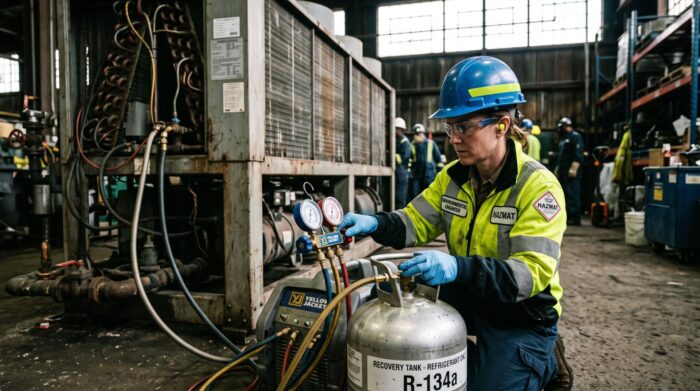
To dismantle this risk, circular industrial protocols require comprehensive lifecycle tracking and closed-loop reclamation. Certified technicians must recover refrigerants during system maintenance and end-of-life disposal using hermetically sealed vacuum recovery units. Instead of treating recovered chemicals as hazardous refuse, specialized industrial facilities can reclaim and distill them back to purity specifications matching newly synthesized virgin gas. When refrigerants degrade beyond recovery, thermal plasma destruction and high-efficiency cement kiln incineration permanently mineralize the fluorinated compounds into inert salts, ensuring they never reach the troposphere.
Product architecture is evolving alongside recovery networks. Appliance engineers are developing cooling devices under strict eco-design standards that prioritize modular assembly, leak-tight joinery, and natural refrigerants. Substances like propane, isobutane, ammonia, and water exhibit negligible ozone depletion potential and have single-digit or zero global warming scores. While early industrial resistance cited flammability and technical hurdles, updated mechanical engineering standards and improved microchannel heat exchangers have made hydrocarbon-based refrigeration both safe and exceptionally energy-efficient. Transitioning to natural refrigerants eliminates synthetic chemical leakage while simultaneously lowering operational electricity demand, easing pressure on regional electrical grids.
Beyond industrial factories and scrap facilities, atmospheric monitoring networks maintain constant vigilance over global gas fluxes. In 2018, atmospheric chemists noticed an unexpected, rogue spike in global trichlorofluoromethane emissions, an ozone-depleting gas supposed to have been entirely eradicated years earlier. Using precision ground-based air sampling stations in East Asia and satellite spectral data, researchers pinpointed the emissions source to illicit polyurethane foam manufacturing in eastern China. The rapid publication of these findings prompted focused domestic regulatory enforcement, and emissions promptly cratered back to their baseline downward trend. This episode demonstrated that environmental treaties require ongoing independent empirical verification rather than passive administrative compliance.
The atmosphere does not distinguish between industrial categories, and emerging technological proposals introduce complex new questions for stratospheric chemistry. Solar radiation modification through stratospheric aerosol injection, an idea occasionally floated as an emergency intervention to reflect sunlight and curb global heating, poses unknown hazards to stratospheric equilibrium. Atmospheric scientists warn that introducing millions of tons of reflective sulfur particles into the stratosphere could alter temperature profiles, disrupt circum-polar jet streams, and inadvertently accelerate chlorine-driven ozone destruction. Preserving the stratospheric blanket requires resisting technological gambits that risk unwinding four decades of delicate atmospheric mending.
Every homeowner, facility manager, and urban policymaker plays a tangible role in maintaining atmospheric integrity. Routine preventative maintenance on residential and vehicular heat pumps catches micro-leaks early, lowering compressor stress and halting chronic fugitive emissions. Municipal building codes that enforce passive cooling designs—such as exterior shading, cross-ventilation, green roofs, and reflective exterior surfaces—diminish reliance on mechanical refrigeration altogether. When purchasing climate-control equipment, choosing products that run on natural alternatives and demanding certified recovery during replacement directly reinforces the circular supply chain.
The continuing renewal of the ozone layer is a potent reminder of what concerted environmental governance can accomplish when guided by precise science, clear enforcement deadlines, and cross-border financial assistance mechanisms. The work, however, is not finished. Fully securing the stratospheric umbrella requires enforcing the phased elimination of hydrofluorocarbons, hunting down illegal chemical manufacturing, and preventing legacy chemical banks from bleeding into the sky as global cooling needs expand exponentially.