



























Every year, as the golden hues of late autumn settle across the Northern Hemisphere on the last Wednesday of October, communities, researchers, and forward-thinking enterprises pause to observe World Sustainability Day. This annual occasion is far more than a symbolic date on the global calendar; it represents a profound moment of collective reflection and a strategic checkpoint for our civilization. At its core, the day is designed to rekindle global awareness, ignite meaningful public discourse, and accelerate the transition toward development models that preserve the living fabric of Earth. In an era characterized by complex environmental crises, the commemoration stands as a clarion call to re-evaluate our systems of production, distribution, and consumption, aligning human aspirations with the finite thresholds of the natural world.
To truly grasp the significance of World Sustainability Day, one must trace the evolution of sustainability itself from a fringe environmental concept to the central organizing principle of modern governance. While indigenous philosophies have emphasized balance, stewardship, and multi-generational responsibility for millennia, modern institutional sustainability gained widespread traction with the publication of the 1987 Brundtland Report, titled Our Common Future. The landmark document defined sustainable development as meeting the needs of the present without compromising the ability of future generations to meet their own. Over the decades that followed, this definition has matured from a simple balancing act between economic growth and conservation into an integrated framework that views ecology, social equity, and economic viability as interdependent pillars of human survival.
The scientific context framing today’s observance is both urgent and unyielding. Groundbreaking research from the Stockholm Resilience Centre into planetary boundaries reveals that humanity has already breached six of the nine critical thresholds that regulate Earth’s stability, including climate change, biosphere integrity, land-system change, freshwater availability, biogeochemical flows of nitrogen and phosphorus, and the introduction of novel chemical entities into the wild. Furthermore, global climate monitors consistently report record-breaking sea surface temperatures, shrinking polar ice shelves, and an intensification of volatile weather events across continents. The ecological overshoot phenomenon underscores the imbalance: human civilization is consuming ecological resources and services at a rate that would require nearly two Earths to sustain indefinitely, drawing down natural capital rather than living off its regenerative yield.
Addressing this historical imbalance requires an uncompromising departure from the traditional linear economic paradigm, often summarized as the extract-transform-dispose model. For over two centuries, industrial progress has relied on the false assumption that raw materials are limitless and that the biosphere possesses an infinite capacity to absorb toxic waste. World Sustainability Day places the spotlight firmly on the urgent necessity of closing the loop through the circular economy. Transitioning to circularity means designing out waste and pollution right at the blueprint stage, keeping products and materials in high-value circulation for as long as possible, and regenerating natural systems. It shifts the definition of prosperity from the sheer velocity of throughput to the resilience, durability, and restorative power of economic networks.
The technological landscape offers remarkable reasons for measured optimism as clean alternatives consistently outcompete their fossil predecessors on both efficiency and economic merit. Over the past decade, the levelized cost of solar photovoltaic energy and onshore wind power has plummeted by over eighty percent, turning renewable sources into the cheapest electricity generation options in history. Across continents, national grids are undergoing massive overhauls, integrating smart grid infrastructure, decentralized microgrids, advanced battery storage systems, and green hydrogen solutions to ensure baseload reliability. The global energy transition is no longer a speculative fantasy; it has evolved into an unstoppable industrial migration driven by market logic, technological innovation, and societal demand for cleaner air.
Parallel to the energy transformation is a vital revolution in agriculture and food systems, which currently account for nearly a third of global greenhouse gas emissions and are the primary driver of biodiversity loss. On World Sustainability Day, agroecological voices increasingly highlight regenerative farming as an indispensable solution. By minimizing mechanical soil tillage, eliminating synthetic chemical inputs, rotating diverse crops, and planting deep-rooted cover vegetation, regenerative agriculture rebuilds organic matter in depleted soils, enhances water retention, and transforms vast agricultural acreage into dynamic carbon sinks. Healing the land does not merely mitigate climate disruptions; it restores soil microbiomes, protects pollinator species, and ensures nutritious, food-secure futures for an expanding global population.
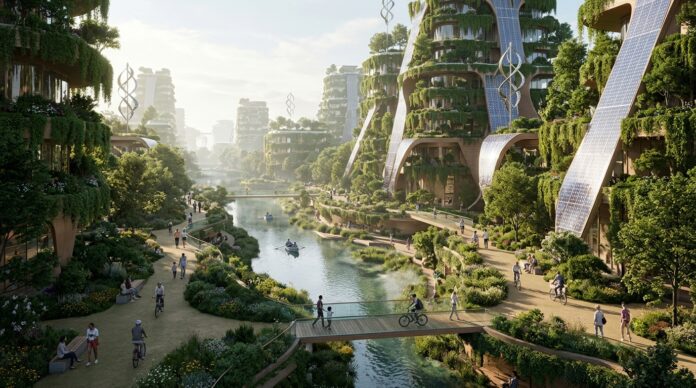
Urban centers, home to more than half of humanity and responsible for seventy percent of global carbon emissions, are emerging as critical testing grounds for ecological innovation. Cities worldwide are shedding their concrete-heavy, car-centric blueprints in favor of biophilic urbanism and human-scaled planning. The concept of the fifteen-minute city, where daily essentials are accessible via walking, cycling, or clean public transit, is revitalizing neighborhoods while reducing transport emissions. Concurrently, nature-based engineering solutions, such as permeable pavements, urban wetlands, and extensive vertical greening, transform concrete jungles into resilient sponge cities capable of mitigating extreme heat islands, absorbing torrential stormwater, and reintroducing native flora into daily metropolitan life.

Water stewardship and marine conservation form another indispensable frontier highlighted by this annual commemoration. Marine ecosystems, which produce half of the oxygen we breathe and absorb a quarter of anthropogenic carbon dioxide emissions, face unprecedented pressures from acidification, coral bleaching, destructive industrial fishing, and non-biodegradable microplastic debris. The sustainable blue economy calls for a radical overhaul of our relationship with oceans and inland waterways. Investing in the restoration of coastal mangroves, salt marshes, and kelp forests offers extraordinary returns, providing natural storm barriers, safeguarding marine nurseries, and sequestering carbon at rates up to ten times faster than terrestrial forests, proving that coastal protection and ecological restoration work in absolute harmony.
Material science is undergoing its own profound transformation, shedding toxic synthesis in favor of bio-based, circular alternatives inspired by nature. Biomimicry—the practice of emulating biological models, systems, and elements to solve complex human challenges—is pioneering energy-neutral architectural designs, self-healing materials, and nontoxic adhesives inspired by natural polymers. Concurrently, the urgent campaign to eliminate forever chemicals such as per- and polyfluoroalkyl substances (PFAS) and single-use petroleum plastics has catalyzed the rapid development of compostable packaging derived from agricultural byproducts, seaweed, and mycelium, demonstrating that industrial packaging can safely return to the soil cycle as organic nourishment.
This systemic transition cannot occur without structural changes in global finance, governance, and corporate accountability. In recent years, sustainable finance has moved from a niche investment preference into the global mainstream, with sovereign green bonds and ESG-guided portfolios directing trillions of dollars toward low-carbon infrastructure. However, the integrity of these capital flows demands strict oversight to eliminate greenwashing—the deceptive practice of exaggerating ecological credentials. Robust regulatory frameworks, standardized carbon accounting, and mandatory life-cycle disclosure mechanisms are increasingly holding corporations accountable, ensuring that investments translate into measurable, verifiable improvements on the ground.
Crucially, the ecological transition must be fundamentally rooted in social justice, equity, and human dignity. A sustainable future cannot be built upon the exploitation of vulnerable populations, nor can it ignore the disproportionate impact of ecological degradation on the Global South and marginalized communities. The framework of a just transition guarantees that workers previously reliant on extractive industries are provided with comprehensive retraining, well-compensated green jobs, and active roles in the new economy. True sustainability demands an inclusive social architecture where clean energy, pristine drinking water, healthy food, and unpolluted air are universally recognized as fundamental human rights rather than exclusive privileges.
Beyond high-level corporate pledges and national policy directives, World Sustainability Day serves as a powerful reminder of personal and civic agency. Grassroots movements, community gardens, local repair cafes, and zero-waste networks underscore the immense influence of collective civic engagement. Individual choices—embracing plant-rich diets, rejecting planned obsolescence, demanding circularity from retailers, reducing domestic food waste, and holding elected representatives accountable—coalesce into potent cultural shifts. When millions of conscious choices synchronize, they exert decisive pressure on corporate supply chains and political agendas, driving the systemic transformations our planet urgently requires.
Education and ecological literacy stand as the foundational bedrock of this lasting cultural evolution. Instilling environmental stewardship within educational curricula from early childhood through higher education dismantles the outdated anthropocentric worldview that places humanity apart from nature. As emerging generations learn to view themselves as active, reciprocal participants within living ecological systems, they gain the skills, ethical frameworks, and creative capacity needed to invent the regenerative industries of tomorrow. Ecological knowledge transforms passive anxiety into active, organized, and optimistic agency capable of navigating planetary complexity with clarity and courage.
Ultimately, World Sustainability Day is neither a self-congratulatory celebration nor an exercise in catastrophic despair. It is a working summit of human conscience, an invitation to acknowledge how far we have journeyed while confronting the vast, uphill expanse of the road ahead. The goal of sustainability is not merely survival or perpetual sacrifice; it is the realization of a thriving, abundant, and equitable civilization living in stable symbiosis with the living planet. As the final Wednesday of October passes, the true work begins: turning the ideals of this international day into daily habits, resilient policies, and enduring infrastructure that will safeguard the beauty, richness, and vitality of Earth for generations yet unborn.