
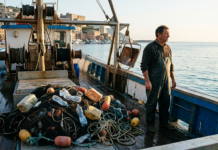
























A quiet paradox is unfolding along the sun-drenched docks and historic ports of the Italian peninsula. Every morning, hundreds of trawlers and artisanal fishing vessels return from the open waters of the Mediterranean, their nets heavy not only with the day’s catch of sea bass, red mullet, and sardines, but also with an overwhelming volume of synthetic debris. Ghost nets, degraded plastic bottles, discarded packaging, and industrial fragments emerge from the sea floor, dragged up by crews who spend their lives on the water. These maritime workers possess both the willingness and the practical means to serve as frontline guardians of ocean health, acting as an essential ecological filter for an increasingly fragile marine ecosystem. Yet, instead of unloading this daily harvest of plastic into organized port reception facilities, they frequently find themselves compelled to cast it back into the blue depths from which it came.
This counterproductive cycle is not born of negligence or indifference on the part of fishing communities. Rather, it represents the unintended consequence of an administrative bottleneck that has paralyzed one of Europe’s most ambitious environmental initiatives: Italy’s Salvamare Law. Passed with unanimous cross-party support as Law 60 in May 2022 after years of dedicated civic mobilization, the legislation was celebrated internationally as a groundbreaking blueprint for circular marine stewardship. It established for the very first time that litter accidentally retrieved in fishing gear should no longer be categorized as commercial industrial waste, but rather as marine litter eligible for free deposit at dedicated port collection points, fully integrated into municipal waste management networks.
To guarantee that the financial burden of this national cleanup operation would not fall unfairly upon coastal municipalities or fishermen themselves, the system was designed with an equitable fiscal mechanism. Italy’s Regulatory Authority for Energy, Networks and Environment introduced a specific component into the national household waste tax, known as the Tari. Since then, millions of Italian families have faithfully paid this modest contribution on their recurring utility invoices, confident that their money was financing the continuous extraction, sorting, and ecological treatment of plastic waste retrieved from their shared territorial seas. Public participation has been universal, peaceful, and financially sound, yet the promised public service remains largely frozen on paper.
The root of this systemic failure lies in the prolonged absence of the executive implementing decrees that were supposed to be drafted and signed by the Ministry of Environment and Energy Security. While primary legislation creates the legal framework, it requires secondary regulations to establish operational criteria, determine traceability protocols, allocate responsibilities between port authorities and municipal waste collectors, and clarify safe disposal and recycling channels. In the regulatory vacuum left by these missing decrees, the legal regime governing waste transportation remains rigidly punitive. Any boat captain who brings non-organic maritime waste onto their deck and transports it into a commercial harbor without specific, highly complex commercial waste-carrier licenses risks being charged with the criminal offense of illicit waste trafficking.
The human and ecological reality of this bureaucratic gridlock was recently thrust into national prominence by an investigative television report broadcast on Italian public service network Rai 3. In the program, seasoned fishermen documented the stark composition of their routine hauls off the Italian coastline. In one striking sequence, a single fishing run yielded roughly thirty kilograms of edible fish set against an astonishing seventy kilograms of marine plastic debris. Confronted with the complete lack of authorized reception points at their home pier and terrified of facing devastating financial penalties or vessel impoundment, the crew explained with visible frustration that they had no legal alternative other than tipping the synthetic cargo over the gunwales, returning the plastic directly to the currents.
This heartbreaking scene catalyzed an immediate public reaction, prompting veteran ocean conservation organization Fondazione Marevivo to escalate its pressure on institutional leaders in Rome. Marevivo had championed the original concept of the Salvamare Law as far back as 2018, conducting pioneering pilot projects in coastal regions like Manfredonia and the Tuscan archipelago to demonstrate that fishermen were eager to become the custodians of their marine territories when provided with basic logistical support. The foundation’s president, Rosalba Giugni, issued a passionate and unequivocal appeal directed directly to Environment and Energy Security Minister Gilberto Pichetto Fratin, demanding the immediate signature and promulgation of the overdue ministerial decrees.
Giugni noted that Italian taxpayers have shouldered their civic responsibility without complaint, funding a circular collection mechanism that remains trapped midway across the stream of administrative execution. She emphasized that maritime workers, who should be honored as invaluable allies in ecological restoration, are instead trapped between the ethical desire to clean the ocean and the practical necessity of protecting their livelihoods from catastrophic administrative fines. Every single week that passes without regulatory clarity results in dozens of metric tons of durable polymers sinking back down to vulnerable benthic habitats, where they smother coral gardens, suffocate marine vegetation, and gradually break down into microscopic particles.
The Mediterranean basin is uniquely vulnerable to the devastating impacts of plastic accumulation. Although it accounts for less than one percent of the global ocean surface, it contains some of the highest concentrations of microplastics anywhere on the planet due to its semi-enclosed geography, dense coastal urbanization, and intensive maritime traffic. When durable consumer packaging and synthetic fibers remain submerged for extended periods, exposure to ultraviolet solar radiation, mechanical wave action, and salinity degrades the material into microplastics and nanoplastics. These minuscule particles are readily ingested by zooplankton, bivalves, and small pelagic fish, entering the marine trophic web and bioaccumulating through commercial species until they reach the plates of human consumers.

Beyond the direct threat to biodiversity and human health, the current operational stalemate represents a monumental missed opportunity for the regional circular economy. Plastic retrieved fresh from sea beds often consists of valuable high-density polyethylene, polypropylene, and industrial-grade nylon derived from discarded nets and ropes. When promptly diverted into dedicated terrestrial recycling streams, these high-value technical polymers can be mechanically reprocessed, granulated, and reintegrated into closed-loop manufacturing cycles for sustainable textiles, architectural materials, and durable goods. Instead of feeding industrial symbioses that reduce reliance on virgin fossil feedstocks, these valuable secondary raw materials are left to deteriorate in marine trenches.
The economic logic of operationalizing the Salvamare Law is as compelling as its ecological rationale. Modernizing harbor infrastructure to accommodate segregated collection skips, automated weighing systems, and mobile washing facilities creates green employment opportunities in port communities across southern and central Italy. Moreover, cleaning seabed corridors reduces the extensive mechanical damage suffered by commercial fishing vessels, whose propulsion propellers and expensive nets are frequently torn or fouled by submerged plastic debris, causing millions of euros in annual maintenance expenses across the maritime sector.
Public administration experts point out that the financial resources required to install and manage these harbor facilities are already sitting in earmarked public accounts, having been gathered through the Tari waste surcharge over multiple fiscal quarters. The fiscal mechanism created by ARERA functions precisely as intended, illustrating that citizens are more than willing to contribute economically when presented with a transparent environmental purpose. What has broken down is not civic trust or financial liquidity, but the administrative transmission belt within central government ministries, where inter-departmental technical consultations have stalled the final authorization of operational guidelines.
Conservation biologists stress that time is an unforgiving variable in ocean restoration. A single plastic container discarded in maritime waters can take over four centuries to decompose, fragmenting into millions of invisible toxic vectors that attract persistent organic pollutants from surrounding seawater. The fishermen of the Mediterranean possess an irreplaceable asset that no high-tech oceanic recovery drone can easily match: an intimate, generational knowledge of submarine canyons, seasonal tides, and benthic currents. They know precisely where plastic fields congregate on the ocean bed, and their daily navigational routes cover millions of square nautical miles without requiring additional public fuel expenditures for dedicated cleanup vessels.
To convert this vast, dispersed nautical workforce into an active environmental defense brigade requires nothing more than regulatory common sense. The pending ministerial decrees must explicitly clarify that marine litter retrieved during normal commercial fishing constitutes special public waste rather than private industrial residue, establishing safe harbor rules that shield boat masters from transport infractions. They must further obligate maritime directors and municipal waste utilities to maintain clearly designated, accessible drop-off bays along harbor quays, staffed with trained personnel to verify quantities and coordinate immediate sorting.
The environmental community remains inherently constructive, expressing full confidence that Minister Pichetto Fratin and the technical directors of his ministry can resolve this lingering impasse with a single decisive stroke of the pen. The political consensus that enabled the Salvamare Law in 2022 crossed every ideological divide, demonstrating that healthy seas represent a fundamental national interest that transcends partisan maneuvering. Unlocking these decrees would provide an inspiring demonstration of institutional accountability, reassuring the Italian public that their fiscal contributions directly translate into measurable environmental regeneration.
Around the world, maritime nations struggling with ocean plastic waste have looked to Italy’s Salvamare legislation as a model of forward-thinking environmental jurisprudence. If fully implemented, it offers a replicable template for empowering traditional fishing industries, modernizing port logistics, and mobilizing civic solidarity in the service of marine biodiversity. Coastal communities, scientific researchers, and environmental organizations stand ready to collaborate with government agencies to ensure that harbor drop-offs run smoothly, transparently, and effectively.
As dawn breaks over Mediterranean harbors tomorrow, fishing boats will once again cast off their moorings, navigating toward horizons dotted with the floating remnants of our modern consumer culture. The nets will be cast, and once again, tons of seabed debris will be hauled out of the shadows and into the sunlight. Whether that plastic is hauled safely onto concrete docks for recycling or dumped in despair back into the open sea depends entirely on the political courage and administrative speed of the decisions made in Rome. The citizens have paid, the ocean needs help, and the fishermen are waiting for the green light to bring the sea back to life.