





















The submerged engine of terrestrial climate stability
Planet Earth is, by its very geophysical nature, an ocean planet. Seas and oceans cover over 70% of the global surface, enclosing 97% of all water and constituting the largest continuous living space in the biosphere. However, beyond their inestimable value in terms of biodiversity and economic livelihood for coastal communities, planetary water masses perform an irreplaceable thermodynamic and chemical function: they act as the primary regulator of the terrestrial climate. Since the dawn of the industrial era, oceans have absorbed over 90% of the excess heat trapped in the atmosphere due to anthropogenic greenhouse gas emissions and roughly 30% of the carbon dioxide (CO2) produced by burning fossil fuels, deforestation, and heavy industrial processes. Without this massive and constant global buffering action, average atmospheric temperatures would be dramatically higher today, rendering vast portions of the continents entirely inhospitable to human and animal life.
This extraordinary biogeochemical storage capacity lies in what the international scientific community defines as “Blue Carbon,” which is the carbon sequestered, fixed, and stored by marine and coastal ecosystems. Although terrestrial forests (so-called “Green Carbon”) are historically celebrated as the lungs of the Earth, coastal marine ecosystems – which occupy less than 2% of the total ocean surface – display a sequestration efficiency per unit area that can exceed that of tropical or temperate rainforests by up to ten times. This potential resides in the ecological structure of specific environments such as seagrass meadows, mangrove forests, and salt marshes. Unlike terrestrial soils, where the decomposition of organic matter rapidly releases CO2 into the atmosphere if the ground is exposed or disturbed, marine sediments are inherently anoxic (oxygen-depleted) environments. Under these hydraulic and chemical conditions, bacterial degradation is extremely slow, allowing the organic carbon trapped in roots and mud to remain buried and isolated for centuries, if not millennia.
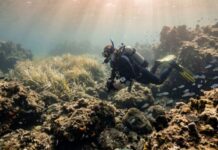
Within the specific context of the Mediterranean Sea basin, the absolute protagonist in this energy balance is Posidonia oceanica, a higher aquatic plant (equipped with roots, stem, leaves, flowers, and fruits) endemic to our waters. Posidonia meadows are not mere algae, but genuine submerged forests that form imposing structures known as mattes — a compact tangle of rhizomes, roots, and trapped sediment that accumulates vertically over centuries at millimetric rates. Posidonia mattes constitute genuine geological carbon vaults, capable of immobilizing massive amounts of greenhouse gases beneath the sea level. Furthermore, the meadows stabilize seabeds by countering coastal erosion caused by storm surges, oxygenate the waters through photosynthesis, and offer breeding, nursery, shelter, and feeding grounds to over a quarter of the marine species recorded in the Mediterranean.
The fever of the seas: marine heatwaves and acidification
This immense blue lung is currently in a state of severe and acute vulnerability due to the crossing of the planet’s biophysical boundaries as observed across 2026. The continuous accumulation of thermal energy in the upper layers of the oceans has triggered the phenomenon of marine heatwaves—prolonged periods of abnormally high sea temperatures extending from the surface down to dozens of meters deep. Scientific monitoring conducted by research institutes, including the historical analysis of global thermal trends, highlights that Italy and the entire Mediterranean basin are recording extreme thermal anomalies, with surface waters approaching temperatures typical of tropical seas. These thermal peaks put a heavy strain on the physiological tolerance of Posidonia oceanica and sessile organisms (such as gorgonians and orange corals), causing mass mortality events, leaf shedding, and the structural fragmentation of historical meadows.
Alongside thermal stress, the very chemistry of the oceans is undergoing a silent but devastating transformation: acidification. By absorbing vast atmospheric portions of CO2, seawater undergoes a series of chemical reactions leading to an increase in the concentration of hydrogen ions, causing a reduction in pH and, consequently, a decrease in the availability of carbonate ions. The latter are the fundamental building blocks used by marine “calcifying” organisms — such as mollusks, crustaceans, sea urchins, and coralline algae — to synthesize their protective shells and skeletons in calcium carbonate. In a more acidic environment, calcification becomes energetically expensive or entirely impossible, and existing limestone structures literally risk dissolving. The collapse of these organisms at the base of the marine food web risks propagating via a domino effect through all commercial fish species, threatening global food security.
The degradation of Posidonia meadows and coastal ecosystems also triggers a dangerous positive climate feedback loop. When a meadow dies or is destroyed by direct anthropogenic activities (such as reckless anchoring, illegal bottom trawling, or pollution from coastal runoffs), the structure of the matte destabilizes. The centuries-old accumulated sediment is exposed to the erosive action of currents and dissolved oxygen, reactivating bacterial decomposition processes. Consequently, what has been a secure carbon sink for millennia suddenly turns into a massive emission source, releasing huge volumes of previously stored CO2 into the atmosphere and further accelerating ongoing global warming.

Biotechnological strategies for ecological restoration and active protection
The international scientific community and marine bio-engineering have realized that passive conservation alone is no longer sufficient to reverse the course of ocean degradation; it is necessary to implement active ecological restoration strategies on a large scale. One of the most innovative techniques developed in recent years consists of underwater reforestation via the transplantation of Posidonia oceanica cuttings. Researchers collect the leaf bundles naturally uprooted by storms and accumulated on sandy seabeds, preventing their death, and fix them onto special biodegradable supports anchored to the marine substrate. These supports, made of corn-derived bioplastics or natural coconut fiber nets, hold the plant in a stable position for the time necessary (usually two to three years) for new roots to develop, penetrating the sediment and anchoring firmly on their own.
Alongside manual transplantation, digital technology and underwater robotics are offering unprecedented predictive monitoring tools. The use of Autonomous Underwater Vehicles (AUVs) equipped with ultra-high-resolution cameras and artificial intelligence algorithms (Computer Vision) allows for real-time mapping of meadow density, identifying early signs of thermal stress or structural regression. This data is cross-referenced with IoT sensors placed on oceanographic buoys, which constantly record parameters such as pH, salinity, temperature, and water turbidity. Big Data predictive analysis allows maritime authorities to intervene promptly, establishing temporary navigation or anchoring bans in the most vulnerable areas, protecting submerged vegetation during the most intense heatwaves.
Concurrently, research is focusing on regenerating marine trophic webs through the creation of biomimetic artificial reefs placed around restoration areas. These structures, manufactured via 3D printing with eco-friendly materials such as geopolymer mortars based on clay and calcium carbonate, not only physically block the destructive passage of illegal bottom-trawling fishing nets but also offer cavities, niches, and rough surfaces that mimic natural reefs. This stimulates the settlement of calcareous algae, mollusks, and natural predators, accelerating the restoration of native biodiversity and creating a protected microclimate that favors the natural expansion of surrounding Posidonia meadows.
World Oceans Day as a call for global responsibility
The complexity of the ecological challenges affecting the marine biosphere finds its moment of ultimate synthesis and international mobilization on a fundamental date for our planet: June 8th marks World Oceans Day. Officially established by the United Nations, this global event represents a formidable sounding board to remind governments, industries, and civil society that the health of the oceans and the survival of the human species are two sides of the exact same coin. Oceans are not simply a massive water basin to be exploited or an invisible dumping ground for our waste, but the beating heart of the global climate system, the engine that generates over 50% of the oxygen we breathe, and the primary bulwark against atmospheric thermal collapse.
The celebration of World Oceans Day must translate into concrete and binding political commitments, starting with the strict implementation of the UN High Seas Treaty, which aims to protect 30% of ocean spaces by 2030 through the establishment of a global network of Marine Protected Areas. On local and national scales, it is a priority to eliminate land-based pollution by modifying agricultural and industrial practices that discharge tons of nitrogen, phosphorus, and macro-plastics into rivers. Reducing the use of synthetic chemical fertilizers prevents the eutrophication of coastal waters—a process that strips light and oxygen from seabeds, smothering Posidonia and accelerating marine desertification.
In conclusion, protecting blue carbon sinks and regenerating the oceans requires a profound cultural revolution in our relationship with nature. Every citizen is called upon to make conscious daily choices, reducing their individual carbon footprint, rejecting single-use plastics that fragment into microplastics and poison the marine food chain, and supporting responsible fish consumption from traceable and sustainable supply chains. The oceans have protected us for over a century by silently absorbing the shocks of the climate crisis, paying an incredibly high biological and chemical price. Today, the time of ecological tolerance has run out: protecting and restoring the Earth’s blue lungs is the most important, urgent, and forward-looking investment humanity can make to ensure its own survival and hand down a still livable, prosperous, and blue planet to future generations.