













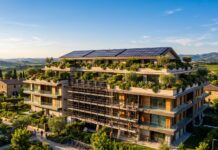














A 5% increase in the amount of tree cover in cities would lead to a reduction in air pollutants[1] that would prevent around 5,000 premature deaths per year. This is the finding of an international study involving ENEA, conducted in 744 cities in 36 European countries, published in The Lancet Planetary Health and carried out as part of the European LIFE project “Airfresh”. Furthermore, the research showed that up to 12,000 deaths per year could be avoided if every city centre had at least 30% tree coverage.
“In urban areas, fine particulate matter, nitrogen dioxide and ozone are among the most dangerous pollutants for our health and that of ecosystems. By 2050, it is estimated that around 80% of the European population will live in urban areas, accentuating the importance of these issues,” explains ENEA project coordinator Alessandra De Marco, head of the Laboratory for Impacts on the Territory and Developing Countries. ‘Increasing the number of trees in cities,’ she adds, ‘would bring simultaneous benefits such as improved air quality, mitigation of the summer heat island effect, conservation of biodiversity and, above all, the well-being of citizens.’
The United Nations Economic Commission for Europe (UNECE) recommends adopting the 3-30-300 strategy, which consists of achieving three specific objectives: 3 trees visible from every home, school or workplace, 30% tree cover in every neighbourhood and a maximum distance of 300 metres from one’s home to a park or public green space.
Using an integrated approach combining European environmental and health data[2] over a 20-year period (2000-2019), the study found that average tree cover increased by just 0.76 percentage points and that 73.5% of the cities analysed recorded an increase in green space. At the same time, mortality attributable to air pollution decreased by an average of 3.4%. In 2019, 130 of the 744 European urban centres surveyed (over 50 million inhabitants, or about 25% of the population of these centres) had an average tree cover of more than 30%. Currently, in Italy, vegetation cover reaches 30% only in Naples (32%), while in Milan and Rome it reaches 9% and 24% respectively.
“A 30% urban tree cover, as achieved by some European cities, could reduce premature deaths by 9.4% from PM2.5, 7.2% from nitrogen dioxide and 12.1% from ozone. Conversely, reducing tree cover to zero would lead to an increase in mortality: +19.5% from PM2.5 (approximately 19,000 more premature deaths each year), +15% from nitrogen dioxide (over 5,200 more) and +22.7% from ozone (approximately 700 more),” De Marco points out. The benefits of urban greenery do not stop at air quality; trees can reduce the perceived temperature, mitigating the impact of heatwaves such as the one in the summer of 2022, which caused approximately 62,000 deaths in Europe (+4%).
The EU Biodiversity Strategy for 2030 commits member states to planting at least 3 billion trees by the end of the decade to significantly increase average tree cover in cities. “To achieve this goal, planting programmes should target not only public spaces but also – and above all – private spaces, such as residential courtyards, as well as peri-urban areas. It is essential that urban planners and administrators are encouraged to integrate urban green infrastructure tailored to different local contexts. This approach should be accompanied by emission reduction policies and complementary measures, such as cold air corridors or green roofs, to maximise the benefits in terms of public health and quality of life, resulting in cities that are more sustainable and resilient to climate change in the long term,” concludes De Marco.