

























Across contemporary public discourse, a misleading narrative has occasionally emerged suggesting that citizens and commercial enterprises have grown weary of ecological ambitions amid persistent inflation and unpredictable geopolitical turbulence. However, empirical reality paints an entirely different picture, demonstrating that Italian society is more committed than ever to addressing climate instability. A groundbreaking nationwide investigation carried out by research institute Ipsos Doxa, presented in conjunction with the 29th edition of Ecomondo and the 15th National Council for the Green Economy in Rimini, reveals an overwhelming collective consensus. More than three out of four citizens, accounting for seventy-six percent of the population, actively demand that institutions, industrial bodies, and civic communities significantly intensify their climate intervention efforts.
Far from being an isolated debate confined to academic circles, youth movements, or environmental non-governmental organizations, the climate crisis has established itself as an inescapable everyday reality for a broad spectrum of the population. The research highlights that sixty percent of Italians experience genuine and sustained worry regarding global warming, with heightened concern expressed particularly by women, young people under twenty-five, and older demographics over fifty-five. These groups do not merely observe ecological changes from a detached viewpoint; they recognize the tangible threat posed to agricultural stability, civil infrastructure, and communal public health, voicing a profound apprehension that conditions will deteriorate without systemic adaptation and decisive greenhouse gas mitigation strategies.
This heightened public awareness has virtually marginalized eco-skepticism across the Italian peninsula. The survey demonstrates that outright skepticism regarding climate realities has shrunk to a negligible fourteen percent, proving that misinformation campaigns and efforts to downplay planetary boundaries are failing to sway public conviction. Rather than adopting an attitude of paralysis or passive resignation, more than seven out of ten respondents declare a clear willingness to adopt greener personal lifestyles, affirming that restructuring national energy architecture must be treated as an indisputable collective priority. Furthermore, roughly forty-one percent believe that Italy should lead by example and push forward with transformative resilience measures even if other global actors fail to fulfill their international climate pact commitments.
One of the most transformative and unexpected discoveries emerging from the Ipsos Doxa study resides within the productive heart of the country. For years, conventional wisdom has assumed that business leaders and manufacturing executives were resistant to ecological regulation, favoring industrial inertia over environmental compliance. The survey shatters this assumption by revealing that commercial leaders are voicing sharp dissatisfaction with the current pace of change. A resounding sixty-four percent of businesses describe the general trajectory toward ecological modernization as agonizingly slow, while an astonishing seventy-four percent express deep frustration over the sluggish deployment of the clean energy transition, viewing bureaucratic hesitation as a structural barrier to modern industrial progress.
Italian industry is awakening to the realization that long-term survival and international competitiveness depend fundamentally on shedding reliance on unpredictable global fossil commodity markets. Enterprises that have confronted exorbitant utility expenditures, supply chain shocks, and impending regulatory frameworks like the European Carbon Border Adjustment Mechanism are eager to secure domestic, localized, and predictable zero-emission energy supplies. When factory owners, industrial innovators, and commercial operators actively criticize national transitions for being too slow, it becomes abundantly obvious that sustainability has transformed from an ethical consideration into an urgent economic imperative capable of determining who thrives in the global marketplace.
When citizens are invited to identify the most critical strategic pillars for confronting climatic disruption, pragmatic and infrastructure-focused solutions take precedence. Leading the list of priorities, identified by over thirty-eight percent of respondents, is the immediate reduction of fossil fuels accompanied by an aggressive expansion of renewable sources like solar, wind, and sustainable bioenergy. Closely trailing behind, with more than thirty-five percent support, is the structural advancement of energy efficiency and conservation across residential buildings and industrial processes. In addition, one-quarter of the public emphasizes the indispensable role of crystal-clear communication and education, while over twenty-four percent highlight the absolute necessity of maintaining international diplomatic pressure to guarantee multilateral cooperation.
The study also delves deeply into how lingering geopolitical instability and energy supply shocks have affected citizen psychology regarding national self-sufficiency. Rather than retreating into old, high-emission habits out of fear, fifty-five percent of Italians argue that the safest and most economically sound path forward involves drastically severing fossil fuel imports and pouring investment into renewable infrastructure. For this majority, generating clean electricity domestically represents the most reliable shield against volatile international energy suppliers, mitigating domestic electricity bills while reinforcing national sovereignty. Nonetheless, lingering anxieties remain noticeable, with twenty-eight percent considering the temporary reopening of decommissioned coal plants and one in five suggesting a reconsideration of civil nuclear power as stopgap measures.

Crucially, the survey puts to rest the pervasive misconception that ecological responsibility comes at the expense of national economic prosperity. Approximately fifty percent of surveyed individuals express a firm conviction that accelerating the adoption of clean technology will simultaneously stimulate economic competitiveness and protect the biosphere. Conversely, merely one in four people cling to the outdated view that investing heavily in climate neutrality undermines Italy’s industrial stature. The dominant consensus is that technological innovation, circular resource management, and clean power generation represent the most effective engines for high-quality job creation, manufacturing revitalization, and regional development.
Reflecting on these findings, Edo Ronchi, President of the Foundation for Sustainable Development, pointed out that the tangible impacts of ecological disruption and the crushing financial burden of oil and gas reliance have fundamentally altered public sentiment. He noted that those who anticipated widespread eco-fatigue or expected the public to abandon green commitments will find themselves profoundly mistaken. Italian citizens are not turning away from climate challenges; rather, they are becoming far more discerning, recognizing that delaying structural reforms creates greater vulnerabilities for household budgets and national economic resilience.
From the industrial exhibition sector, Alessandra Astolfi, Global Exhibition Director of the Green and Technology Division at Italian Exhibition Group, highlighted that awareness among both ordinary citizens and corporate enterprises has reached unprecedented heights. She reiterated that the fundamental challenge facing society is no longer convincing individuals that a climate problem exists, but actively transforming shared consciousness into scalable, concrete engineering solutions. Accomplishing this requires concerted synergy across governmental institutions, financial entities, and technological developers to translate environmental ambition into physical industrial infrastructure.
Adding social perspective to the research, Andrea Alemanno of Ipsos illuminated how citizens navigate today’s multifaceted polycrisis. Even when confronted by elevated living costs, inflation, and international conflicts, people steadfastly refuse to accept ecological breakdown as an unavoidable destiny. Alemanno underscored that the public actively seeks institutional partnership, recognizing that individual consumer choices are insufficient if political leaders and major corporations do not enact systemic reforms. He warned that organizations and political figures that dismiss or betray these societal expectations will inevitably face accountability from conscious consumers, dynamic workers, and an increasingly volatile climate.
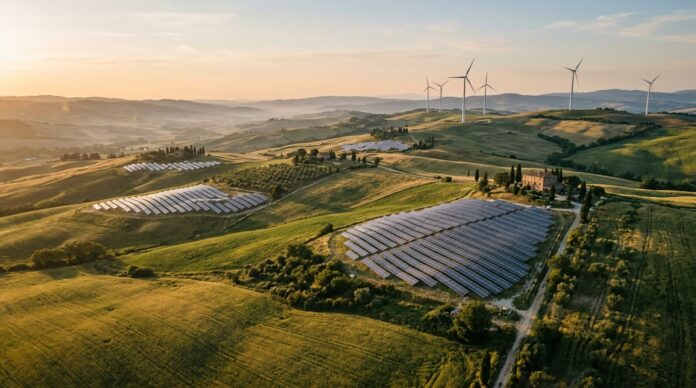
To answer this societal demand, national policymaking must urgently pivot from timid, incremental measures to decisive regulatory streamlining. Accelerating the deployment of utility-scale renewables requires eliminating administrative logjams, modernizing energy grids with advanced storage solutions, and expanding localized energy communities. By allowing small and medium enterprises, agricultural operations, and residential cooperatives to produce, store, and share clean power, communities can slash overhead costs while decentralizing national energy distribution. Such decentralized models directly democratize the transition, proving that the shift to decarbonization can generate localized, shared wealth.
Furthermore, this public appetite for decisive environmental action reinforces Italy’s strategic advantage within the circular economy. Italian manufacturing already leads Europe in industrial recycling efficiency, secondary raw material utilization, and resource conservation. Capitalizing on this existing expertise allows domestic firms to design durable, recyclable products and eliminate waste streams, simultaneously mitigating supply chain risks associated with imported critical raw materials. Marrying clean energy with circular production principles provides Italian industry with a decisive competitive edge on the global stage, transforming environmental stewardship into an engine of export excellence.
The findings presented ahead of Ecomondo and the National Council for the Green Economy make it abundantly clear that the real bottleneck in the ecological transition does not lie in societal reluctance or corporate pushback. Both the workforce and commercial leadership are actively demanding speed, clarity, and bold leadership. What the country now requires is institutional courage: a collective governance framework capable of distributing the economic advantages of decarbonization fairly, dismantling outdated regulatory barriers, and turning national willingness into transformative reality. The momentum for profound change is undeniable, and the road ahead offers an extraordinary opportunity to build an equitable, clean, and fiercely competitive green economy.