

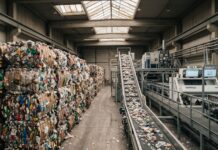























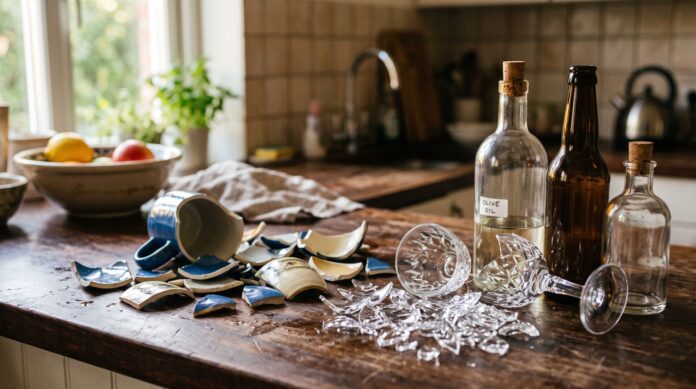
Few moments in domestic life trigger as immediate an instinct to clean up as the sound of something shattering on the kitchen floor. Whether it is an everyday porcelain mug slipping from soapy fingers, a heat-resistant baking dish cracking under thermal shock, or an ornamental mirror toppling from a hallway wall, our first reaction is to sweep up the fragments and toss them directly into the recycling bin. After all, if it looks like glass, feels like glass, and breaks like glass, it must belong with the bottles and jars. Unfortunately, this seemingly logical impulse represents one of the most persistent, expensive, and damaging sorting mistakes in modern municipal waste management.
The fundamental misunderstanding stems from treating glass as a monolithic, universal material. In reality, modern homes are filled with a complex spectrum of mineral compounds, ceramic formulations, and engineered glasses tailored to withstand extreme temperatures, provide crystal-clear optical clarity, or reflect light flawlessly. The green or blue municipal bins placed outside our homes are not generic catch-alls for hard, brittle substances; they are specifically calibrated for soda-lime packaging glass. When non-packaging items slip past sorting checkpoints, they act as silent saboteurs, threatening the efficiency of circular recycling loops and damaging industrial smelting equipment.
To understand why a simple broken teacup or an oven-safe casserole dish cannot share the same fate as a clean wine bottle, we must delve into the physics of the furnace. Packaging glass, known chemically as soda-lime glass, is composed primarily of silica sand, soda ash, and limestone. It melts predictably at approximately one thousand four hundred degrees Celsius, turning into a glowing, malleable liquid that can be endlessly reformed into fresh bottles and jars without degrading in quality. This infinite recyclability makes glass the undisputed hero of sustainable packaging, saving immense quantities of virgin raw materials and reducing energy consumption across global supply chains.
Ceramics, porcelain, earthenware, and terracotta, however, operate on entirely different chemical and thermal rules. Formed from dense clays and fired during production at extremely high temperatures, ceramic materials do not melt at the temperatures maintained in industrial glass recycling furnaces. When pieces of a shattered ceramic plate enter a furnace mixed with crushed cullet, they remain solid. As the molten glass cools and hardens into new bottles, these unmelted ceramic fragments become trapped inside the freshly blown glass walls. These inclusions create microscopic stress points and invisible structural flaws. A beverage bottle containing even a speck of ceramic dust can explode spontaneously under standard carbonation pressure or shatter during filling, posing severe risks to workers and consumers alike.
Pyrex, Duralex, and other heat-resistant cookware present an even more deceptive trap because they appear identical to standard transparent glass. These culinary workhorses are made from borosilicate glass, which incorporates boron trioxide into the silica matrix. This chemical alteration grants them an extraordinarily low coefficient of thermal expansion, allowing home cooks to transfer a baking dish straight from a scorching oven to a kitchen counter without fracturing. However, that exact heat resistance makes borosilicate glass disastrous in a conventional recycling plant. Borosilicate requires far higher temperatures to melt than ordinary soda-lime glass. If a single Pyrex lid ends up in the furnace, it remains semi-solid or creates viscous clumps that render the entire batch of molten glass unworkable, forcing plants to discard metric tons of contaminated material.
Mirrors and crystal glassware complete the rogues gallery of false friends of glass. Mirrors are not just clear glass panes; they are composite materials coated with an ultra-thin backing layer of silver or aluminum, protected by industrial varnishes, paints, and chemical sealants that prevent corrosion. When melted, these backing compounds release noxious gases and contaminate the pure silica matrix. Lead crystal, long favored for wine goblets, decanters, and chandeliers due to its dazzling brilliance and acoustic chime, contains significant percentages of lead oxide. Introducing lead into modern food-grade glass packaging violates stringent health and safety standards that protect consumers from toxic heavy metal leaching. Consequently, crystal must never be allowed near standard packaging containers.
Given these strict material boundaries, the practical question remains: where should these broken items actually go when accidents happen at home? For small domestic breakages of ceramics, porcelain, stoneware, Pyrex, crystal, and mirrors, the correct destination in the vast majority of urban waste collection systems is the non-recyclable residual waste bin, often referred to as the general waste, dry waste, or undifferentiated bin. While consigning any mineral material to landfill or waste-to-energy incineration feels counterintuitive to eco-conscious citizens, sending a ceramic shard to the residual bin is infinitely greener than risking the contamination of hundreds of kilograms of genuinely recyclable glass.
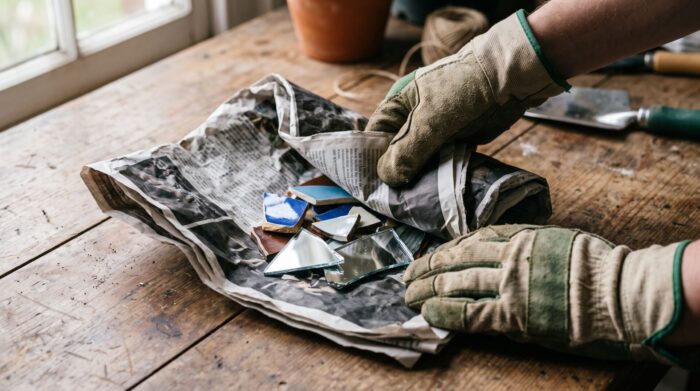
However, safety must take precedence before anything is tossed into the bin liner. Jagged shards of broken porcelain, shards of mirror glass, or razor-sharp fragments of broken drinking glasses can effortlessly slice through standard plastic garbage bags, creating severe laceration hazards for you, your family, and the sanitation workers handling municipal waste. Never dump loose, bare shards directly into a trash bag. The golden rule for handling broken items is encapsulation. Collect all fragments carefully using a broom and dustpan, wipe the floor with a damp paper towel to capture microscopic splinters, and wrap the debris securely. You can wrap the pieces in several layers of old newspaper, seal them inside a sturdy cardboard box taped shut, or place them into an empty, thick cardboard cereal box before dropping them into the general waste.
The disposal route changes when dealing with larger volumes, substantial household renovations, or bulky items. If you are replacing a large bathroom vanity mirror, dismantling a glass shower door, clearing out boxes of cracked antique chinaware, or disposing of a shattered glass tabletop, the domestic general waste bin is neither suitable nor legally permitted due to weight and volume limits. Large mirrors, sheet window glass, wired architectural glass, and extensive ceramic debris must be transported directly to your local municipal recycling center or civic amenity site. At these centralized facilities, separate skips are designated for inert construction rubble, architectural flat glass, and bulky items, where specialized mechanical recycling or safe aggregate downcycling can take place.
Navigating the boundary lines of glass disposal often leads to subtle questions about common everyday objects. For example, what should be done with ordinary drinking tumblers made of standard clear glass? While they might not contain lead, drinking glasses are frequently tempered or chemically strengthened to survive daily use and dishwasher cycles, which slightly shifts their melting behavior compared to hollow packaging glass. The international standard recommendation by glass recycling federations is straightforward: if it did not originally contain a purchased food, beverage, or cosmetic product as packaging, keep it out of the bottle bank. Preserve the glass bin strictly for bottles, jars, flacons, and vials.
Even within the category of legitimate packaging glass, proper preparation is key to supporting high-quality circular loops. Bottles and jars should be thoroughly emptied of all food residues, liquids, sauces, and oils. A quick scrape with a spatula or a rinse using leftover dishwater is generally sufficient; there is no need to wash jars with hot clean water and detergent, as doing so wastes water and energy. Furthermore, while sorting facilities are equipped with powerful magnets and eddy-current separators to extract metal caps and lids, removing metal screw tops, crown corks, and cork stoppers beforehand significantly lightens the industrial burden and allows each component to enter its respective recycling stream cleanly.
Discrepancies between local authorities add another layer of complexity to everyday recycling routines. While the fundamental incompatibility of ceramics and Pyrex with soda-lime glass remains a universal physical reality across the globe, municipal guidelines on handling window panes, drinking glasses, and cosmetic bottles can vary markedly from one council or region to another. Some municipalities have introduced dedicated collections for flat architectural glass, while others permit metal lids to remain loosely attached to jars. When visiting another town, moving into a new district, or managing waste while traveling, assuming that the rules from your hometown apply seamlessly can quickly lead to inadvertent contamination.
Eliminating this confusion is precisely where modern digital tools step in to bridge the gap between good environmental intentions and accurate municipal practices. A prominent ally in this everyday ecological effort is the SmartRicicla app. Because waste sorting regulations, collection schedules, and container color codes differ substantially from one municipality to the next, having a reliable pocket guide is invaluable. Whether you are at home, on vacation, or traveling for business, SmartRicicla utilizes your device geolocation to instantly pinpoint your exact municipality, providing immediate access to verified local sorting rules, collection calendars, and precise guidelines for every single household item. It delivers effortless, zero-cost environmental intelligence that turns waste sorting doubts into second nature.
Mastering household waste separation is not about achieving rigid perfection, but about cultivating informed awareness of the materials we touch every day. Recognizing that a ceramic cup is essentially fired earth, that a Pyrex dish is a thermal fortress, and that a mirror is a chemically coated optical device allows us to respect the distinct life cycles of these everyday objects. By keeping these false friends far away from the glass collection bin and sealing them safely for the general waste or the municipal recycling depot, we protect public workers, safeguard circular industrial processes, and ensure that our true glass packaging can be reborn endlessly, pristine and unbroken, for generations to come.