













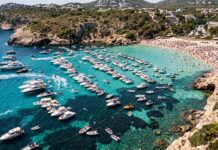





Descending below the surface of the water in the Gulf of Naples and perceiving the heat of the bare rock simply by touching the seabed. It is the physical, tactile, and unsettling experience from which the denunciation by Rosalba Giugni, president of the Marevivo Foundation, begins, aiming to shine a spotlight on a phenomenon that is altering the biology and thermodynamics of the Mediterranean. The water around the island of Capri has crossed the threshold of 30 degrees Celsius, losing its usual clarity to assume an unnatural and dense turbidity. An unequivocal signal that anticipates the numbers collected in recent weeks by the scuba division of the environmental association, which is engaged in mapping a thermal anomaly of unprecedented proportions.
The data coming from the monitoring carried out by affiliated diving centers along the Italian coasts provide an exact radiography of the state of stress our sea is experiencing. Divers’ thermometers have recorded peaks of 34 degrees at the surface, maintaining values between 27 and 30 degrees in a bathymetric band ranging from ten to twenty meters deep. The most technically severe element detected by Marevivo’s teams concerns the sinking of the thermocline, that transition layer separating the surface waters heated by solar radiation from the naturally colder deep water masses. Currently, this thermal barrier has lowered to twenty-five meters. Benthic organisms, accustomed for millennia to living at stable and much lower temperatures, now find themselves exposed to continuous and fatal thermal stress.
The consequences of this deep warming are consumed away from public view, in the absolute silence of the seabed. Public perception of the climate disaster is strongly tied to terrestrial images: wildfires devouring hillsides, riverbeds reduced to stone, alpine glaciers collapsing into valleys, scorching asphalt in metropolises. Marine heatwaves, on the contrary, produce no visible smoke from satellites nor ash falling on cities. The water maintains its blue color and its apparent immutability, hiding a chemical-physical alteration that is redrawing the food chain and the habitat structure of the basin.
Beneath the surface, the biology of the Mare Nostrum is losing ground. The Posidonia oceanica meadows, a true submerged green lung and formidable blue carbon sink, are undergoing vast bleaching phenomena. Subjected to extreme temperatures, the leaves lose pigmentation, become almost transparent, and cease to perform their vital functions, depriving countless fish species of refuge and reproduction areas. In parallel, the gorgonian forests, the large colorful sea fans that make up the three-dimensional scaffolding of Mediterranean coralligenous reefs, are literally dying, suffocated and burned by the anomalous heat of the water. Several native species are disappearing from zones they have colonized for centuries, forced to migrate toward more northern latitudes or dive deeper in a desperate search for cold currents, leaving room for thermophilic alien species capable of thriving in these new tropical conditions.
The destruction of benthic habitats is inextricably linked to human survival dynamics on land. The oceans and seas act as the planet’s primary thermal regulator. They function like a gigantic global radiator, having thus far absorbed the vast majority of the excess heat generated by anthropogenic greenhouse gas emissions. Through the complex system of ocean currents, water stores thermal energy and redistributes it, mitigating the global climate and determining seasonal rainfall patterns. A boiling sea, saturated with heat down to 25 meters deep, progressively loses its efficiency in this compensation mechanism. The energy stored by water masses transforms into meteorological fuel, ready to discharge onto coasts in the form of autumn storms of unprecedented violence, fueling extreme phenomena such as medicanes, the Mediterranean hurricanes.
Faced with this physical scenario, the alarm raised by Marevivo’s leadership demands a paradigm shift in the debate on European and national climate policies. The current public agenda appears heavily oriented toward passive defense tactics. Urban interventions are designed to reduce concreted surfaces, funds are allocated to implement green infrastructure in towns, new adjustments to working hours are studied to protect construction workers, and healthcare networks are strengthened to protect vulnerable demographics from heatstroke. These are measures dictated by extreme urgency, amply justified by a health toll of 35,000 deaths associated with extreme temperatures recorded on the European continent. Numbers that, as highlighted in Rosalba Giugni’s open letter, outline the impact of a silent war, reminding us that what is at stake is not a generic idea of nature, but the endurance of public health and social stability.

However, focusing public resources exclusively on survival strategies triggers a lethal political short-circuit. Adapting to the new climate normal means, in fact, resigning ourselves to a continuous deterioration of living conditions. Designing metropolises capable of withstanding 45 degrees in the shade solves a short-term emergency but does not defuse the mechanism that will cause temperatures to rise further in the coming decades. Mitigation remains the only operational lever capable of preventing the collapse of marine and terrestrial ecosystems from becoming irreversible. Real action requires drastic macroeconomic interventions to cut carbon dioxide and methane emissions at their root.
The ecological transition no longer allows for lag times. A definitive and programmed break from the economy based on fossil fuel extraction and consumption is needed, accelerating the infrastructure of electrical grids to accommodate large shares of energy produced from renewable sources. At the same time, production chains require a profound conversion: from the sustainable, low-carbon redesign of the global agri-food system—which has an enormous impact on nutrient runoff into the seas—to the systematic adoption of circular economy principles to zero out virgin raw material extraction and the subsequent release of industrial pollutants. Protecting the oceans and defending marine biodiversity is not a separate chapter of political action, but the fundamental prerequisite for keeping the land habitable.
And yet, the geopolitical framework marginalizes reformist pushes. Decarbonization plans struggle to translate into binding legislation, blocked by the structural resistance of fossil industries and constantly sidelined by international current events marked by high-intensity armed conflicts, which are humanitarianly destructive and devastating in their pollution levels. In this fragmented context, calls for collective responsibility toward ecosystems risk falling into the void of a public debate distracted by daily emergencies.
The Marevivo foundation, operating in the field for over forty years with a dense network of researchers, marine biologists, divers, and educators, documents a history made of victories on the environmental protection front: from the establishment of marine protected areas to the modification of regulations on ship discharges, up to the ecological education of thousands of students. Today, however, the partial successes of local conservation are overwhelmed by the shockwave of systemic warming that knows no administrative borders. The heat of the water does not stop at the perimeters of marine reserves. Boundary buoys cannot shield corals from temperatures of 34 degrees.
The question placed at the center of the debate by the organization overturns the reassuring narrative we are accustomed to. The past few months have set thermal records across the entire peninsula, but the summer of 2026 might not be remembered in meteorological archives as the peak of a temporary anomaly. Given current emission projections, we risk looking back at this season, twenty years from now, as one of the last relatively cool and mild summers in the planet’s history. The Mediterranean’s warming trajectory indicates an inclined plane where every additional tenth of a degree causes exponential damage to benthic and pelagic marine organisms.
To principled observations and fatalistic wishes about the future of the climate, the network of researchers contrasts the solidity of an empirical approach. The thermal logs and bathymetric measurements collected by diving centers along the kilometers of the Italian coast will now be transferred in full to research institutes. Mapping with millimeter precision the extent of calcareous algae bleaching, gorgonian mortality, and the downward shift of the thermocline provides the scientific community with the physical data necessary to calibrate new mathematical models of climate impact.
The political diagnosis dictated by the seabed sets rigid timelines. The technical margin to intervene on the root causes of ocean warming is now measured in years, narrowing the field of action and canceling any justification for further postponements in the global decarbonization calendars. Abandoning the waters of the Mediterranean to their thermal fate is equivalent to giving up the protection of the coasts, the climate, and the economy that derive from it, unloading the burden of inaction onto an ecosystem that has reached beyond the threshold of physical collapse.