













Off the coast of Bogliasco in the Ligurian Sea, a newly deployed underwater structure is currently serving as an active biological refuge. Scorpionfish, octopuses, and moray eels have begun colonizing the Posidonia Art Reef, a submerged installation specifically designed to merge marine biology with local citizen science. Recognized rapidly as an international case study by the European Horizon Europe program, the project shifts the paradigm of coastal infrastructure from passive concrete blocks to active, monitored ecological restoration. The precise operational data and community-driven methodology behind this artificial reef are now arriving on the southwestern coast of Sardinia.
From August 27 to 30, the mechanics of marine preservation, alien species management, and aggressive coastal pollution will dominate the eleventh edition of the Big Blue Festival. Hosted within the historical stone walls of the Antica Tonnara Su Pranu in Portoscuso, the event organized by ArgoNautilus brings field researchers, geologists, and environmental operators directly to the edge of Capo Altano. The agenda systematically strips away the romanticized view of the ocean as a silent sunset backdrop, treating the Mediterranean instead as an active, highly vulnerable entity that demands strict biological accountability.
The biological reality of the Mediterranean basin requires immediate diagnostic attention. Festival artistic director and biologist Maurizio Cristella frames the current ecological decline through a precise medical lens. He notes that certain severe pathologies within the human body remain completely invisible until a physician learns to recognize the early symptoms. The degradation of marine ecosystems operates on the exact same principle. Without an educated gaze capable of spotting the initial signs of systemic failure, environmental interventions arrive only when the damage is entirely irreversible. The Portoscuso gathering attempts to train this specific scientific gaze across four days of public analysis.
Edoardo Brodasca, director of the Posidonia Green Project, brings the Ligurian reef model directly to the Sardinian public. His international organization operates extensively between Spain and Italy, pushing an eco-responsible societal framework based on the direct correlation between human health and marine stability. Brodasca’s reef is not a top-down engineering feat dropped blindly into the ocean. He defines the installation as a new model of cultural and ecological infrastructure, capable of redesigning the relationship between community and sea. Local residents co-designed the structures alongside young marine biologists, turning everyday citizens into active monitors of underwater biodiversity.
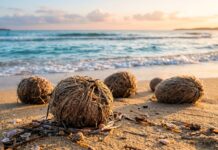
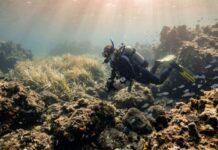
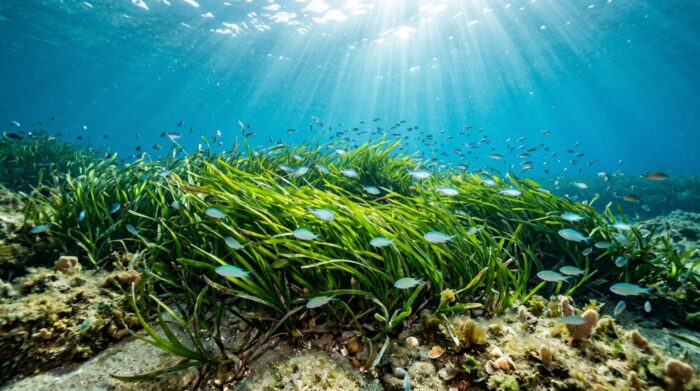
The transfer of this knowledge to Sardinia is highly strategic and urgently needed. The island’s extensive coastline faces severe biological pressures, demanding exactly this type of localized, scientifically backed community engagement. The visual evidence of this underwater wealth is documented meticulously by the Subacquei per la Scienza association. Their latest photographic mapping of the Sardinian seabed exposes the critical density of local biodiversity, focusing heavily on the Posidonia oceanica meadows. These endemic blue forests function as the primary carbon sinks and oxygen producers of the Mediterranean, yet they remain highly susceptible to mechanical damage from unregulated anchoring and rapidly changing thermal gradients.
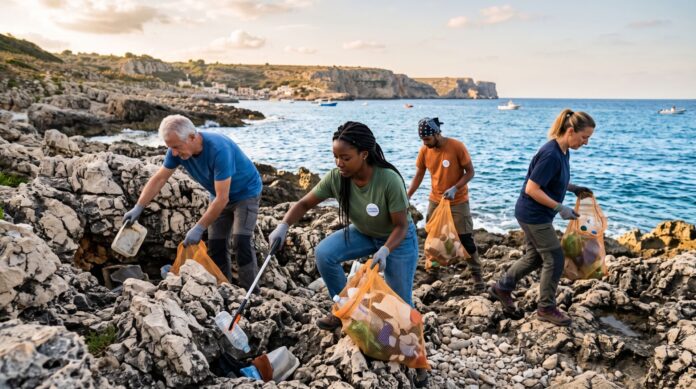
Above the surface, the ecological battle takes a highly physical, exhaustive form. Since 2019, the Marevivo Sud Sardegna delegation has operated across the Sulcis territory, moving rapidly from a small group of twenty individuals to a structured network of seventy active volunteers. Albano Salis, the delegation’s president, tracks the immense volume of synthetic materials his teams extract from the local coastline. Every year, these volunteers pull literal tons of plastic waste, microplastics, and abandoned fishing gear out of the sand and water, operating heavily around the fragile Sant’Antioco lagoon and the exposed Carbonia shores.
Salis frames this intense manual labor not as a simple cosmetic cleanup of tourist beaches, but as a rigid practice of frontline environmental education. Removing debris by hand forces a physical confrontation with the sheer scale of global human consumption. While municipal waste management handles urban centers, the degraded microplastics and foreign marine litter washing up on remote Sardinian shores require continuous, decentralized human intervention. The volunteers act as the primary defense line for these fragile transitional ecosystems, proving that civic awareness directly dictates the survival rate of the local coastline.
These coastal lagoons are currently undergoing aggressive and unprecedented biological transformations. Biologist Sonia Cheratzu maps the rapid changes altering Sardinian wetlands, pointing directly to the increasing pressure exerted by invasive alien species. The blue crab has heavily colonized these shallow, nutrient-rich waters, disrupting the native food web and devastating local bivalve populations. This biological invasion forces a complete reassessment of how regional authorities and fishing cooperatives manage enclosed lagoon ecosystems. The accelerated thermal warming of the Mediterranean has facilitated the proliferation of these non-endemic predators, leaving local marine life with virtually no evolutionary time to adapt or mount a defense.
The rigid scientific data regarding the lagoon finds an immediate, harsh reality check in the daily operations of local maritime workers. Alberto Bardi, a fisherman who operates directly within these shifting waters, provides the empirical counterpart to Cheratzu’s biological analysis. His daily observations track the immediate economic and structural impacts of the blue crab invasion, alongside the shifting currents and altering water temperatures. The collision between academic research and generational fishing knowledge highlights the extreme complexity of managing marine resources in real time, where abstract climate models translate instantly into empty nets and completely altered tidal behaviors.
The festival also targets the widespread dissemination of scientific inaccuracies that severely hamper effective environmental action and policy-making. Geologist Luigi Sanciu systematically dismantles the most entrenched geological myths circulating both locally in Sardinia and globally. In an era dominated by rapid digital misinformation, identifying fake rocks and debunking pseudoscientific claims about the earth’s crust is a vital public service. Public misunderstanding of geological and marine processes often leads to active resistance against necessary environmental policies, making rigorous scientific communication a matter of basic civic defense.
The intricate intersection of terrestrial and marine ecosystems emerges clearly in the detailed research presented by biologist Silvia Cera. Her work investigates the Sardinian Mediterranean scrub as a massive open-air pharmacy, focusing specifically on its symbiotic relationship with pollinating insects. Cera analyzes the largely unexplored potential of endemic flora to provide low-impact, natural pest control strategies. Protecting the coastal vegetation does not merely preserve the aesthetic landscape; it safeguards a complex chemical library that could dramatically reduce the agricultural reliance on synthetic pesticides, chemicals which eventually run off into the sea and systematically destroy adjacent marine habitats.
Cultivating a durable ecological conscience requires infiltrating early childhood education with tangible materials rather than relying on abstract, distant warnings. The Big Blue Festival deploys specific hands-on laboratories aimed at immediate material conversion for younger generations. Children dismantle plastic bottle caps to construct chromatic mosaics, entirely bypassing theoretical lectures in favor of direct tactile engagement with synthetic waste. Another specialized workshop focuses on ecological fashion, teaching young participants that modern sustainability originates in the conscious, creative manipulation of existing materials. These sessions actively reframe trash as a valuable resource, establishing strict circular economy principles long before wasteful consumer habits can fully solidify.
Oral tradition and performative arts serve as the final, critical delivery mechanism for the festival’s dense environmental data. Sicilian storyteller and dancer Alosha merges intense physical movement with the powerful poetic texts of Walt Whitman, Emily Dickinson, and Bertolt Brecht. Guided by the precise narrative curation of Paola Bontà, the multidisciplinary performance physically interprets the friction and potential harmony between human ambition and uncompromising natural laws. The choreography translates dry ecological concepts into kinetic energy, proving that scientific data often requires cultural translation to provoke a genuine, lasting shift in public behavior.
Human curiosity and the aggressive drive to conquer natural spaces frequently override the basic mandate to protect them. Documentary filmmaker Stefano Vascotto examines this exploratory impulse by tracing the historical commercial routes of the East India Company and the grueling twentieth-century expeditions to Mount Everest, known to the Nepalese as Sagarmatha. Vascotto analyzes the exact tipping point where exploration mutates into irreversible exploitation. His Himalayan historical focus intentionally mirrors the current marine crisis, forcing the audience to question the ethical boundaries of human expansion into untouched, extreme environments.
The archaeological footprint left along the coasts provides the ultimate timeline of this complex human-nature interaction. Archaeologist Sara Porru examines the buried heritage scattered beneath the Sardinian soil and submerged in the surrounding waters. Every amphora, sunken shipwreck, and ancient tonnara structure records a specific economic and environmental phase of the Mediterranean basin. Reading this historical stratigraphy offers a clear, undeniable metric of how past civilizations either adapted to or completely exhausted their coastal resources, providing a strict historical precedent for navigating current and future climate challenges.
The final phase of the Portoscuso gathering abandons the traditional conference format entirely for a massive public assembly focused on handmade craftsmanship. A coastal carnival pushes participants to construct their own marine-themed masks and structures exclusively from recovered materials. This specific directive outright rejects the purchase of mass-produced, single-use plastic costumes, enforcing the festival’s core mandate that physical creation and material reuse hold the exact same ecological weight as peer-reviewed research. The event leaves the coastal community staring directly at the shoreline, armed with updated biological data and the urgent, ongoing task of monitoring the incoming tide.