


























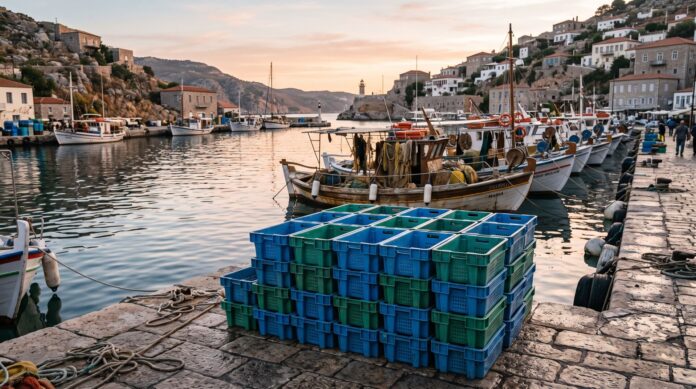
Crates of crushed ice and fresh catch line the quayside at Sciacca, a working port on Sicily’s south-western shore where commercial trawlers dock beside small-scale gillnetters. For decades, the ubiquitous white expanded polystyrene box has served as the default packaging for seafood landed here and across the Mediterranean basin. Lightweight, thermally efficient, and disposable, it has also become one of the most stubborn vectors of plastic pollution in marine waters, fragmenting under mechanical friction and UV radiation into millions of buoyant beads that marine organisms mistake for food. That routine dockside cycle faced direct scrutiny when Costas Kadis, European Commissioner for Fisheries and Oceans, traveled to Sciacca to examine an operational attempt to strip polystyrene out of the seafood supply chain.
The visit centered on BlueFishers, an initiative managed by environmental foundation Marevivo that introduces rigid, reusable fish crates to commercial fishing crews. Kadis observed the distribution of 1,000 reusable containers to 16 local fishers operating across ten vessels, a pilot financed with backing from the Sicily Environment Fund and Verdura Resort. According to Marevivo’s calculations, fully deploying those thousand boxes will prevent an estimated 20,800 single-use polystyrene containers from circulating through the local market and risking accidental loss at sea. The demonstration in Sciacca was intended to show that alternative transport systems can function within working harbours without slowing down fast-paced landing operations.
Addressing fishers, cooperative managers, and regional administrators on the quayside, Commissioner Kadis signaled that the European Commission is assessing how localized packaging trials can inform broader regulatory frameworks. The BlueFishers initiative illustrates how practical collaboration can deliver measurable progress toward European circular economy goals and the reduction of marine pollution, Kadis observed, adding that such efforts must not remain confined to isolated harbours but need replication through coordinated rules, economic incentives, and adequate financial instruments. His presence elevated what began as a regional pilot into an active policy discussion on European fisheries packaging standards.
The logistical trial at Sciacca marks the latest stage of an operational campaign that Marevivo inaugurated in the Tuscan port of Viareggio in 2023. Across its national operations, the project has enlisted roughly 130 fishers, 100 commercial vessels, and 47 fishing cooperatives. Marevivo reports that its participating fleets have received more than 4,200 reusable crates to date, diverting upwards of 60,000 single-use expanded polystyrene boxes from wholesale distribution lines and eliminating the immediate hazard of their loss during transit, deck operations, or portside unloading. The figures illustrate a tangible proof of concept, yet they also underline the immense distance between voluntary harbour schemes and an industry-wide transition.
Expanded polystyrene, known chemically as EPS, consists of roughly ninety-eight percent air encapsulated within a rigid polymer matrix. That composition makes it inexpensive to manufacture and exceptional at maintaining low temperatures, an essential requirement for preserving seafood freshness during transit from vessel hold to wholesale auction. However, those identical physical properties render it ecologically volatile. When a box breaks apart on a slippery deck, falls overboard in rough seas, or degrades under coastal sunlight, it does not dissolve. It crumbles into small spherical pellets that scatter across water surfaces, accumulating in surface slicks and entering trophic webs through benthic feeders and pelagic fish alike.
Coastal cleanups consistently list fragmented foamed plastics among the primary items recovered along European coastlines. Beyond the direct hazard to wildlife from intestinal blockage and the leaching of chemical additives, EPS creates severe logistical headaches for commercial fishermen themselves. Broken foam frequently fouls nets, clogs water intakes on vessel engines, and litters harbour basins where propeller churn accelerates its physical breakdown. Despite widespread awareness of these drawbacks, fleet operators have remained wedded to single-use boxes due to the sheer absence of return-logistics networks and the negligible unit cost of disposable packaging.
Replacing disposable foam with durable plastics or composite materials requires reorganizing the entire downstream economy of fresh fish marketing. A vessel captain unloading at dawn does not merely need a sturdy container; that container must travel through wholesale auctions, enter regional distribution vans, reach fishmongers or supermarket counters, and ultimately return to the dock thoroughly sanitized, inspected, and restacked for the next fishing trip. Without integrated washing infrastructure, standardized dimensions, and clear deposit-return mechanisms, reusable boxes risk becoming stranded assets or operational bottlenecks that individual fishing crews cannot independently manage.
This infrastructural bottleneck forms the core of Marevivo’s ongoing advocacy. Fabio Galluzzo, Vice President of Fondazione Marevivo, pointed out during the Sciacca events that practical field trials prove alternatives are technically viable, but emphasized that voluntary adoption has natural ceilings. BlueFishers shows that effective answers exist and that change is technically possible, Galluzzo stated, but extending these models across the board demands clear national legislation embedded within a coherent European framework that guides the entire fishing sector away from single-use polystyrene. Galluzzo stressed that Marevivo is actively working to coordinate domestic policy advocacy with international environmental networks to establish enforceable regulatory targets.
The regulatory landscape across Italy currently resembles an uneven patchwork of regional ambitions rather than a unified market regime. The Veneto region broke ground by enacting regional legislation that establishes a phased withdrawal of single-use polystyrene containers from its seafood sector, aiming for a full phase-out by 2030. In southern Italy, the regional council of Campania initiated a similar legislative trajectory by drafting proposals that combine transitional incentives with progressive restrictions on EPS usage. Yet these regional initiatives remain territorial exceptions, leaving major fishing basins operating under divergent operational rules and creating friction for supply chains that cross regional borders.
Italy’s fragmented approach highlights the structural limitations of decentralized environmental policy within shared maritime basins. When one port requires reusable crates and a neighbouring maritime district adheres to disposable EPS, wholesale traders and transport fleets face logistical incompatibilities that disincentivize compliance. Vessels landing catches outside their home ports often struggle to recover reusable containers or find compatible washing hubs, while auction houses handling seafood from diverse fleets must manage dual sorting streams. Closing these gaps requires standardized national directives that harmonize port infrastructure, crate tracking protocols, and sanitation mandates across all maritime sectors.
The policy dilemma extends directly to Brussels, where the revision of packaging and packaging waste rules intersects with marine biodiversity strategies and the Common Fisheries Policy. While European directives have increasingly targeted single-use consumer plastics, agricultural and maritime industrial packaging has often slipped through regulatory exemptions due to cold-chain safety concerns and food hygiene standards. The European Maritime, Fisheries and Aquaculture Fund provides financial resources that member states can theoretically allocate to harbour upgrades, crate-washing installations, and fleet retooling, yet national uptake for circular packaging investments has lagged behind traditional vessel modernization spending.
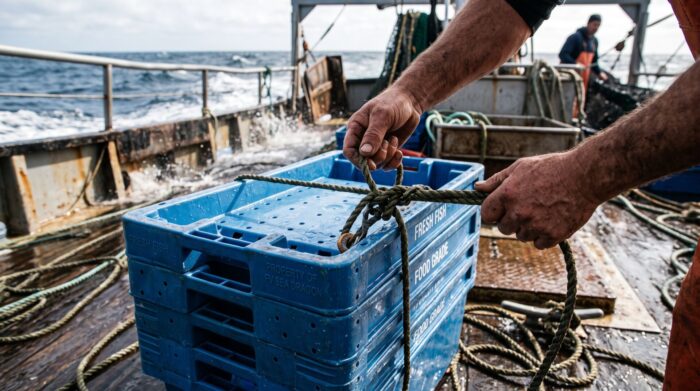
In Sciacca, where fishing forms the cultural and economic backbone of the coastal community, fishers participating in the pilot face the daily mechanics of the shift. The reusable crates deployed under the scheme are manufactured from heavy-duty food-grade polymers engineered to withstand continuous commercial washing cycles, rough deck handling, and automated stacking. They feature drainage designs that divert melted ice away from the fish flesh while retaining structural integrity under heavy loads, addressing common fisher concerns that non-foam alternatives might compromise catch quality or increase bruising during rough passages.
Nevertheless, the economic arithmetic of the transition remains delicate. A standard single-use EPS crate costs wholesale distributors only a fraction of a euro, allowing operators to treat it as an overhead write-off built into the purchase price of the fish. In contrast, rigid multi-trip containers represent a substantial initial capital expenditure that only amortizes over repeated round trips. For small-scale fishers operating on thin profit margins amid rising fuel prices and strict quota constraints, purchasing and managing pools of durable containers without systemic financial support or collective deposit schemes is economically unfeasible.
The success of the Sciacca model will depend largely on the durability of local stakeholder alliances once initial grant funding subsides. The engagement of the Sicily Environment Fund and private sector hospitality partners like Verdura Resort shows how regional tourism and conservation finance can de-risk the initial capital outlays for port communities. However, sustaining a closed-loop system over years requires establishing municipal or cooperative management entities capable of running crate sanitization stations, tracking asset losses, and maintaining replacement pools through modest handling fees rather than external philanthropy.
Marevivo’s roadmap for BlueFishers focuses next on resolving these back-end logistics. The foundation plans to establish structured networks with international ocean advocacy groups to share technical data gathered from Italian harbours, while working with cooperative federations to map port reception facilities that could house centralized washing and storage machinery. By addressing the physical constraints of historic fishing ports—where space on wharves is intensely contested and freshwater supplies can be limited during peak summer fishing seasons—the project aims to turn dockside experiments into turnkey operational templates.
The quaysides of Sciacca demonstrate that the technical hurdle of replacing polystyrene packaging at sea has largely been solved by existing material engineering. What remains unresolved is the administrative and commercial architecture needed to scale those physical solutions across European coastlines. With Commissioner Kadis taking direct field observations back to European policymaking bodies and regional administrations testing autonomous legislative phase-outs, the coming years will test whether European authorities can translate local packaging demonstrations into a binding transition schedule for maritime commerce.