



























The role of the artist in the cultural landscape of 2026 has undergone a radical and irreversible metamorphosis. We are no longer dealing with the romantic figure of the isolated creator producing static forms intended for contemplation in enclosed spaces; the contemporary artist has become an ecosystem designer, a mediator between humanity and the natural world. This evolution has given rise to Eco-Esthetics, a transdisciplinary movement that blends visual pleasure with biological regeneration. The underlying assumption is revolutionary: environmental protection does not necessarily have to involve only deprivation, sacrifice, or the cold rigor of technical data; it can—and must—manifest through the emotional power of beauty. In a world facing unprecedented climate challenges, art serves as a functional bridge to heal the wounds of the Anthropocene.
The Philosophical Roots: From Observation to Action
To understand today’s Eco-Esthetics, one must look at its evolution. While the Land Art of the 1970s used the landscape as a monumental canvas (often altering it without real ecological concerns), today’s approach is diametrically opposed. The art of 2026 is “symbiotic.” It does not impose itself on nature but collaborates with it. Artists study marine biology, botany, and materials engineering, working side-by-side with scientists and climatologists. The artwork is no longer considered finished the moment it is unveiled to the public; rather, it begins to live and complete itself only when nature takes it over, colonizing and transforming it.
Underwater Sculptural Parks: The Ocean’s Breath
One of the most fascinating and impactful examples of this trend is underwater sculptural parks, which have seen a proliferation in recent years, including within the Mediterranean basin. These silent works, resting on the seabed, are made using special bio-active, pH-neutral concrete with porous textures, specifically designed under the microscope to encourage the attachment of coral polyps and calcareous algae.
The visual impact is powerful: life-size human figures and submerged scenes of daily life that, over the months, lose their sharp outlines to become artificial coral reefs pulsing with life. These sculptures offer a safe haven for crustaceans, sponges, and schools of fish in areas previously devastated by bottom trawling. Here, esthetics literally serves to repair what industry has destroyed, while simultaneously attracting conscious scuba tourism that funds the protection of marine areas.
Regenerative Land Art: Stitching the Earth’s Wounds
On land, Eco-Esthetics manifests as the active defense of the territory. In geologically fragile nations like Italy, art has taken the field against hydrogeological instability. Along the Apennine ridge, majestic “Regenerative Art” installations wind their way across landslide-prone slopes. These are not simple sculptures, but complex weaves of reclaimed wood, biopolymers, and natural hemp and willow fibers.
Conceived by artist-engineers, these immense organic webs follow the contour lines of the land. Visually, they resemble ancient fortifications or giant nests, but their function is vital: they slow the runoff of rainwater, trap fertile sediments, and create moist micro-habitats that allow the seeds of native plants to germinate. As the wood rots and nourishes the soil, the roots of the new plants take its place, permanently stabilizing the mountain. It is beauty working for hydrogeological safety.

Bio-Murals and Forest Cities: Urban Art that Purifies
In the beating heart of 2026’s metropolises, street art has ceased to be merely social commentary and has become a cure for the air we breathe. Contemporary murals are painted using next-generation photocatalytic paints. Activated by sunlight, these paints trigger a chemical reaction that breaks down atmospheric pollutants, particularly the nitrogen oxides (NOx) emitted by traffic, transforming them into inert salts that are washed away by rain.
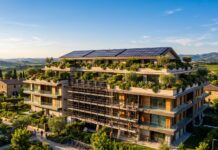
But urban eco-esthetics goes further: wall art now merges with vertical gardens. Building facades become living mosaics where strokes of color alternate with mosses engineered to absorb CO2 and fine particulate matter. Every square meter of this new urban art acts as a lung for the grayest neighborhoods, lowering the surrounding temperature (mitigating the “urban heat island” effect) and providing refuge for pollinating insects.
Beyond Sight: Acoustic Ecology and Soundscapes
Eco-esthetics is not limited to what we can see. A rapidly expanding sector in 2026 is sound art linked to ecology. Acoustic artists install networks of highly sensitive microphones in ancient forests or melting glaciers, broadcasting nature’s “soundscapes” in real-time into city squares or museums. These immersive installations not only create a profound empathetic connection with distant ecosystems but also provide biologists with massive amounts of acoustic data to monitor biodiversity health and the impact of human noise pollution on wildlife.
Forms of Eco-Esthetics in 2026
| Type | Materials | Function |
| Marine Sculptures | Bio-active, neutral pH concrete, porous textures | Promotes coral repopulation and creates habitats for marine life |
| Bio-Murals | Special photocatalytic paints, mosses | Absorption of nitrogen oxides (NOx) and urban air purification |
| Regenerative Land Art | Reclaimed wood, willow, biopolymers | Soil stabilization against erosion and reforestation support |
| Acoustic Ecology | Bio-acoustic sensors, sound installations | Biodiversity monitoring and raising awareness of anthropogenic noise |
| Urban Eco-Design | Recycled plastic (from WEEE) and composites | Reduction of plastic waste and creation of zero-emission urban furniture |
Beauty as a Survival Strategy
Eco-esthetics teaches us the most precious lesson of this decade: sustainability is not, and cannot be, a mere list of prohibitions or protocols to follow; it must become a new cultural language. When art intimately marries science, the ecological message amplifies its voice, proving capable of touching emotional chords that cold statistical data cannot scratch. In 2026, protecting the planet also means re-imagining and redesigning it with harmony. Every action we take, every intervention on the land, if guided by awareness and esthetic taste, can cease to be a harm and transform into a magnificent work of collective regeneration.